
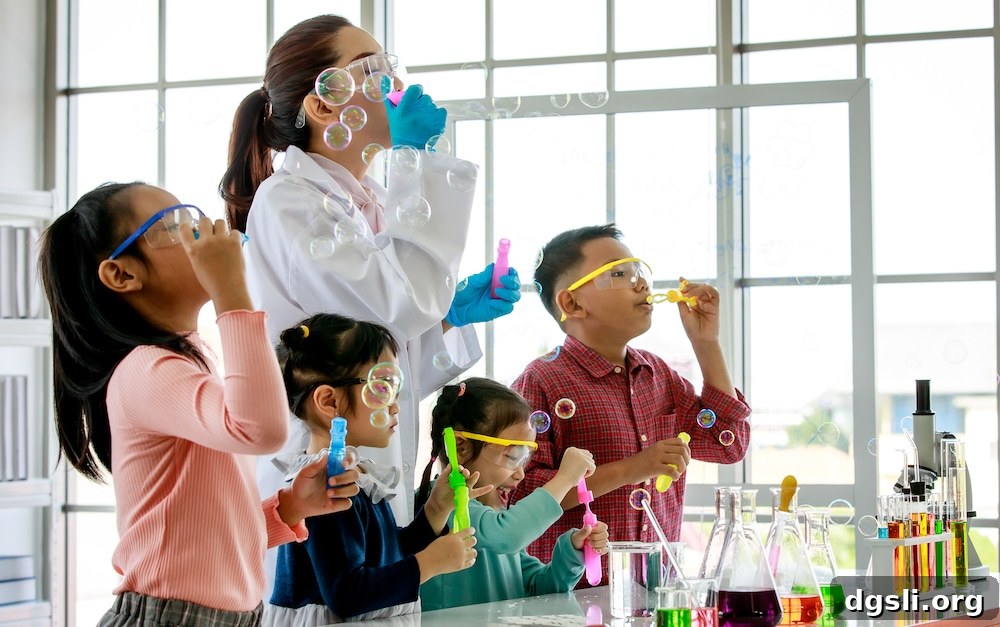
Do you remember a favorite Science teacher or Science class from high school or college? I vividly remember teachers who made science witty, engaging, and fun.
Watching charismatic educators demonstrate experiments often made my school day. Those moments sparked curiosity and made complex ideas feel accessible.
From observing the moon’s phases to learning about plate tectonics, science belongs in every curriculum. One of its greatest strengths is that it’s everywhere: in your backyard, in your kitchen, and across the globe. Science trains us to look at the world from different angles, solve real problems, collaborate, and continually expand our knowledge and opportunities.
What is Science?
Science is the systematic study of the structure and behavior of the physical, natural, and social worlds through observation and experimentation. It is a foundation for innovation and human progress.
As The Science Council explains, science is the pursuit and application of knowledge about the natural and social world using methods grounded in evidence.
The scientific method relies on several core practices:
- Objective observation, precise measurement, and careful data collection
- Use of evidence to support conclusions
- Experiments and observations to test hypotheses
- Inductive reasoning to form general rules from specific facts
- Repetition to confirm results
- Critical analysis and peer review
- Verification through independent testing and scrutiny
Teaching science goes beyond memorizing formulas and vocabulary. It demands clear communication, patience, rigor, and encouragement for students to develop healthy skepticism and independent thinking.
Science helps students understand their world and shows them how they can contribute to solving urgent global problems. Promoting STEM education is central to preparing students for these challenges and opportunities.
From daily decisions to large-scale innovations, scientific knowledge underpins logical reasoning and practical problem-solving. Teachers play a vital role in helping students discover science in everyday life.
Here Are 5 Critical Life Skills Students Can Learn From Science
Science Encourages Creativity
Science begins with questions, not fixed answers, which invites experimentation, iteration, and creative problem-solving. Students learn through trial and error that failure can be informative and that persistence often leads to breakthroughs. Allowing room for exploration nurtures curiosity, resourcefulness, and inventive thinking.
Science Fosters a Love of Learning
A teacher’s enthusiasm for discovery models lifelong learning. Science naturally stimulates curiosity—children are drawn to hands-on activities and tangible experiments. Seeing a dramatic demonstration or completing a compelling project can ignite a lasting passion for learning that carries over into other subjects.
Science Improves Critical-Thinking Skills
Critical thinking in science means analyzing information, weighing evidence, and drawing reasoned conclusions. Students learn to ask:
- Why does this happen?
- What evidence supports this idea?
- How reliable is the information?
- Are there alternative explanations?
- Is the data biased or verifiable?
These practices move students beyond memorization into scientific reasoning and inference. Critical thinking becomes more intuitive with experience, but it must be cultivated through real inquiry, experiments, and reflection. Teachers can design curricula and experiences that help students develop this essential skill.
Science Drives Innovation
Even within systems focused on standardized testing, innovative science teaching is possible. Educators who create inquiry-driven environments let students act like scientists and engineers—asking questions, testing ideas, and solving problems related to real-world issues.
Effective science instruction connects new lessons to students’ prior knowledge and experiences, crosses disciplinary boundaries, and lets learners pursue topics that interest them. When science is taught as an interconnected, applied field, it encourages deeper learning and transferable skills.
Science Builds Relationships—Especially for English Language Learners
Science is collaborative and exploratory rather than rote. It emphasizes questioning, testing, and sharing results, which naturally fosters cooperation and communication—key benefits for English Language Learners (ELLs).
Practical strategies to support ELLs in science include:
- Use visuals—pictures, diagrams, infographics, and charts—to clarify concepts, and integrate music or chants to reinforce vocabulary.
- Provide real-world videos, virtual field trips, and WebQuests that connect lessons to students’ lives. Hands-on activities and safe experiments help make abstract concepts concrete.
- Pair ELL students with supportive native speakers for collaboration, and bring lessons outdoors when appropriate so students can touch, observe, and describe phenomena firsthand.
Additional classroom ideas that combine science learning and language development include researching habitats, building shoebox dioramas, composing songs about animals, and creating videos to present findings.
My colleague, Tom Jekins, an Albert Einstein Distinguished Educator Fellow, says, “Learning science is invaluable because it provides our young people an opportunity to learn the ‘hows’ and ‘whys’ of our very dynamic world. If we also combine experiences that utilize the engineering design process then they will be equipped with the skills to apply this knowledge to create solutions that will benefit humanity (hopefully, the Earth’s plants and animals as well). If we ensure that all students have access to a quality STEM education, the world will become a much better place.”
To engage every student, teach science through experience—not memorization.