
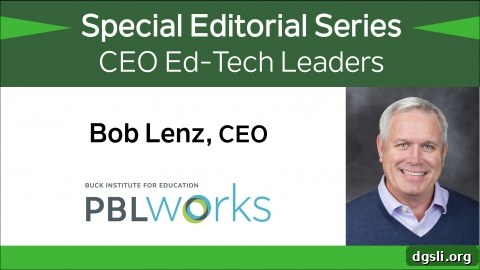
Bob Lenz and PBLWorks: Advancing Project-Based Learning
Editor’s note: This is one in a series of profiles about the men and women who are creating today’s EdTech companies.
By Kenna McHugh
Bob Lenz has served as CEO of the Buck Institute for Education’s PBLWorks since 2015. He brought to the role deep experience in project-based learning (PBL) from his time as co‑founder, CEO, and Chief of Innovation at Envision Education. Under his leadership, Envision developed a widely recognized model that helped underserved urban students from three Bay Area arts and technology high schools successfully transition to and persist in college. Lenz is also the author of the book Transforming Schools: Using Project-Based Learning, Performance Assessment and Common Core Standards.
PBLWorks supports schools, districts, and teachers with resources, training, and coaching to help implement high-quality PBL. The organization’s goal is to prepare students for life beyond the classroom by engaging them in authentic, intellectually challenging work that builds both academic mastery and practical success skills. “The modern workplace is increasingly project-based,” Lenz explains. “People need to collaborate in teams, solve complex problems, and communicate ideas. Project-based learning develops those abilities and also helps students retain knowledge and skills.”
Lenz argues that traditional approaches—rote memorization and passive lecture—no longer serve students well. Many students, even high achievers, are disengaged by schooling that feels disconnected from real-world problems and emphasizes recall over deep understanding. PBL, he says, reconnects learning to meaningful challenges and builds skills such as critical thinking, teamwork, and public communication.
Implementing PBL across a school requires systemic change. “High-quality PBL as routine practice means shifting how schools organize time, design instruction, and support teachers,” Lenz says. Successful adoption depends on coordinated effort from classroom teachers to district leaders, including changes such as scheduling longer class periods, carving out planning time, and easing pressure to simply ‘cover’ content for standardized tests.
A powerful example of PBL’s impact is the story of Yvonne Armenta. A first-generation high-school and college graduate, Armenta credits PBL and her portfolio defense—a curated presentation of student work demonstrating learning and growth—with developing her confidence and agency. Through PBL, she learned to tackle problems, work in teams, present her ideas, and advocate for herself—skills that served her throughout college and beyond. “She wasn’t a passive learner taking notes for exams,” Lenz notes; the portfolio process helped transform her into an active, self-directed learner.
One of the core challenges for PBL adoption is teacher preparation. Most teachers did not experience PBL as students, nor were they trained in it during credential programs. As a result, many default to the methods they experienced in school. To change practice, PBLWorks emphasizes professional development followed by sustained, multi-year support. Their approach includes helping teachers design rigorous projects, model instruction, and refine assessment practices so projects lead to both content mastery and skill development.
Teachers also need a clear mental model of what effective PBL looks like. PBLWorks provides structured training and ongoing coaching so educators can plan projects that teach multiple concepts deeply through a single, authentic challenge. Lenz stresses that PBL does not have to replace all traditional instruction; rather, it should be integrated meaningfully. A realistic goal is for each classroom to carry out at least two high-quality PBL projects per year.
Student readiness is part of the equation. PBL asks learners to operate in new ways: ask authentic questions, collaborate, create products to demonstrate learning, and present work publicly. Initially, some students may feel uncomfortable with these expectations, but with guidance they gain confidence, independence, and transferable skills.
Parent engagement is equally important. Many families are unfamiliar with PBL and may question changes when their child is already performing well under traditional methods. Providing clear information, showcasing student presentations, and involving parents in projects helps build trust and support. Parents often become enthusiastic once they see how PBL develops both academic understanding and real-world competencies.
Another common misconception is that projects take too much time. PBLWorks counters this by showing that projects can be an efficient means of teaching multiple standards while fostering lasting understanding. For example, students learn mathematical concepts more deeply when they apply them to design a house for a client, and science lessons become more meaningful when used to solve a local pollution problem. “PBL is the main course, not dessert,” Lenz often says: a single well-designed project can cover many learning goals while promoting deeper retention and application.
While PBL does not demand extensive technology, PBLWorks has created an online library of project ideas to help teachers get started. The collection includes downloadable project idea cards that were developed and classroom-tested by educators. These ready-to-use designs aim to spark teachers’ creativity and lower the barrier to implementing authentic, standards-aligned projects that develop both academic skills and 21st-century competencies.
In Lenz’s view, PBL can be transformative for all students, especially those furthest from educational opportunity. Because it links classroom work to meaningful problems and real audiences, PBL develops resilient, capable young people who are ready to tackle the challenges of their lives and the world they will inherit.
About the Author
Kenna McHugh is a staff writer at the Learning Counsel. Her work includes writing for film, curriculum development for K–12 programs and educational technology, and tutoring. She contributes to screenwriting and film production projects and helps students develop effective learning strategies.