
By Liz Texeira
Last month I visited students in Kibera, the sprawling informal settlement often described as Africa’s largest slum. In just 1.3 square miles the neighborhood faces acute poverty, frequent violence, and the reality that many families struggle to meet even basic needs. Yet despite those hardships, I met girls who are attending school and dreaming of becoming engineers, teachers, and even neurosurgeons. In Mozambique I met boys and girls who sometimes are the only family members with a daily meal because their scholarship includes school-provided food.
For every teenager I found in a classroom, there were many more back home or working in the village—children pulled out of school because their families simply cannot afford the fees. In numerous developing countries, families still must pay school fees to access secondary education. These costs commonly range from about $250 to $500 per year. To a household living on a few dollars a day, that expense is effectively impossible. Even when schools are available nearby and education promises clearly better lifetime earnings (studies consistently show each additional year of secondary school raises lifetime wages substantially), the price remains a barrier. I spoke with families in Mozambique who asked for a little more corn to feed the children not fortunate enough to have a scholarship.
The contrast is heartbreaking and increasingly familiar. Thanks to the United Nations’ Millennium Development Goals, many countries abolished primary school fees, opening classroom doors to millions of children. That policy shift was crucial and has had tremendous benefits—but it also created new challenges. With fees removed at the primary level, classrooms filled and resources became stretched: overcrowded rooms, too few textbooks, and not enough teachers. The result is that while more children go to primary school, many still drop out once they reach secondary school because fees return as a gatekeeper at that stage.
Today, school fees are one of the leading reasons an estimated 63 million adolescents worldwide are out of school. Secondary-level fees form a bottleneck: students who progressed through primary education find themselves blocked from continuing their studies simply because their families cannot pay.
What made the difference for the students I visited in Kenya and Mozambique? Scholarships. I work with The School Fund, a nonprofit organization that crowdfunds scholarships for academically high-achieving but low-income students in developing countries. Many of these students rank among the top of their primary school classes but face imminent dropout without financial support. Through small donations—often $10, $20, or $50 at a time—our partners and donors help return promising students to the classroom.
We take this work seriously because a scholarship can change a life. One hundred percent of contributions to student profiles posted on our site go directly to that student’s scholarship; operational costs are covered separately by grants and voluntary tips. After payments are made to the student’s school or local partner, a receipt is uploaded to the student’s profile so donors can confirm fees were paid. This level of transparency matters: donors want to see the impact of their support, and students benefit when communities invest in their potential.
 Sometimes the scale of the need feels overwhelming. There are millions of students we cannot reach yet. It can break your heart to see bright young people desperate to continue their education who can do so only if someone with means believes in them enough to pay their way. That reality motivates me every morning to grow The School Fund and spread awareness about the barrier of school fees. We are a crowdfunder that relies on a crowd—more people understanding the problem means more students helped.
A scholarship can create change that extends beyond one student. I think of Veronica, a Maasai girl from Tanzania who now attends a co-educational school ranked among the top ten percent nationally, excels in science, and participates in athletics. I think of Dolly from Bhatpur, India, whose family once feared the long commute to school; with encouragement from a local partner and a scholarship, she returned to classes. These are individual stories, but together they illustrate how education transforms expectations and opportunities.
I care deeply about this work because a relatively small investment—$250 to $500 a year—can be decisive. For many donors that amount is modest; for a family living in poverty it is unattainable. A scholarship can move a young girl from a crowded slum to a future as a scientist, doctor, or teacher. Education gives young people the tools to expect more for their lives and to improve the prospects of the next generation.

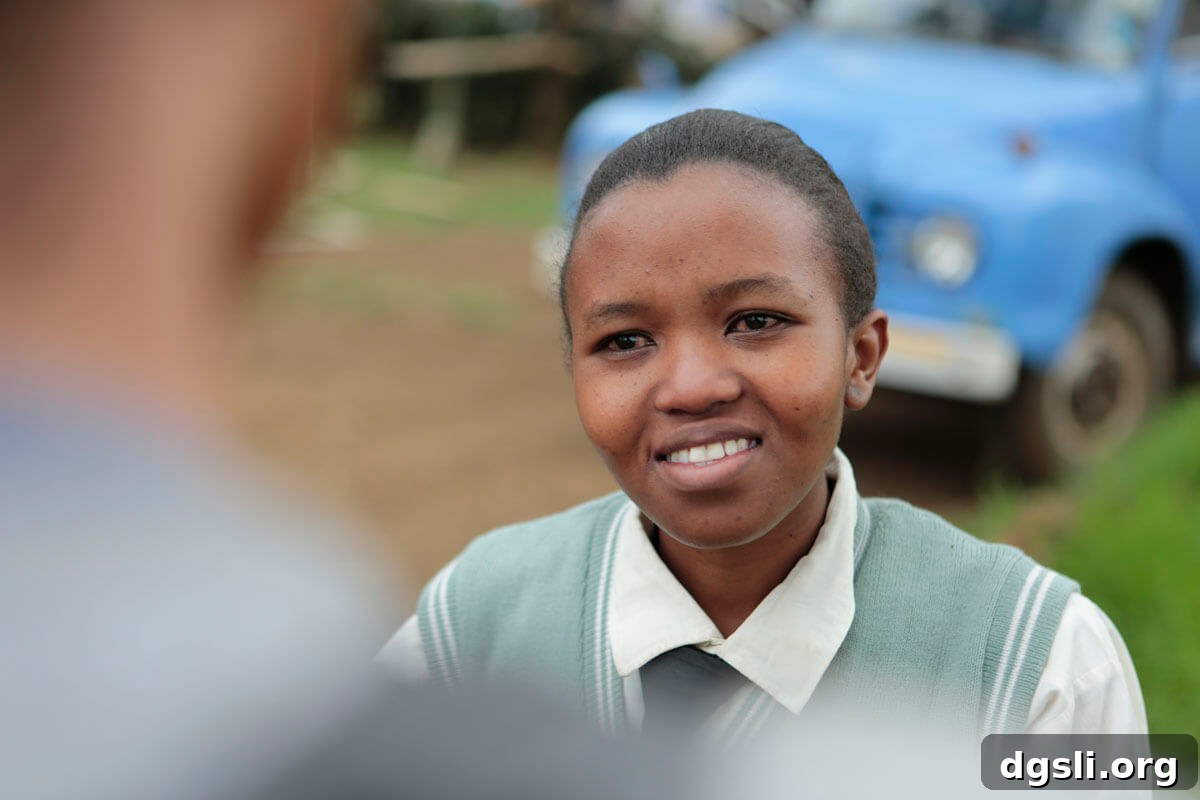
Mary Brenda, a SHOFCO student
About the author: Liz Texeira has devoted her career to education both in the United States and abroad. She attended Harvard on scholarship for her undergraduate degree and holds a Master’s in International Education Policy. Liz founded Girls Thinking Global, works in girls’ empowerment, served with Teach For America, and has worked as an emergency medical technician and education specialist across Northern Africa and the Middle East. At The School Fund, she focuses on engaging diverse audiences, donors, and partners to increase awareness of school fees and to create scholarships for high-achieving, low-income students in the developing world.