
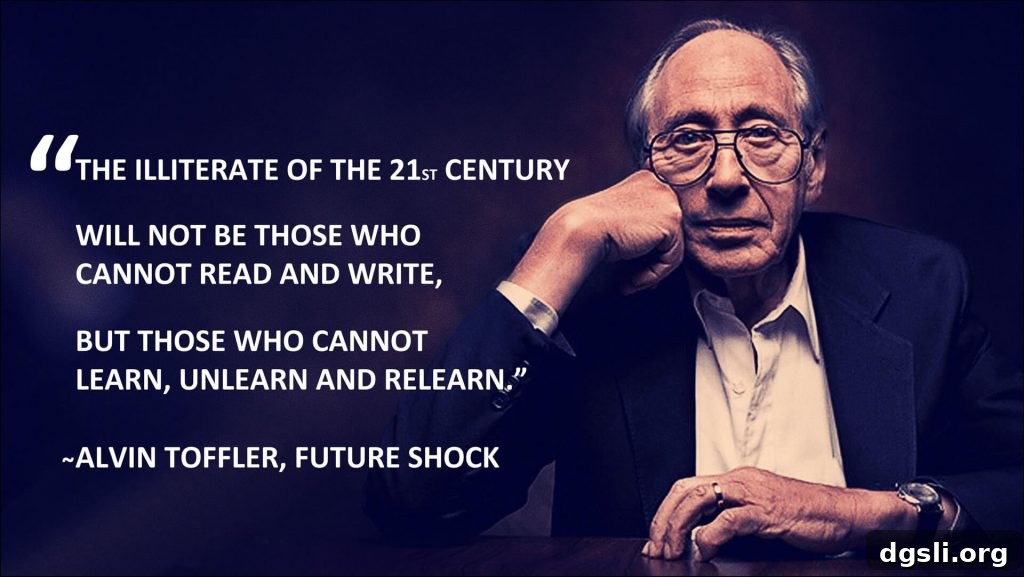
It’s Time to Unlearn & Relearn Learning
This article was originally written and published by Rich Carr of Carr Knowledge. You can read more at Brain-centric Design.
Our capacity to learn, think, create, and adapt gave our species the evolutionary advantage to become one of the most successful on Earth. Yet despite that potential, the U.S. education system loses vast numbers of young learners each year to boredom, stress, and disengagement.
These same learners will memorize thousands of game characters or spend hours leveling up in video games, but many act out, drop out, or turn away from school in alarming numbers. Sir Ken Robinson and others have argued that modern American education remains trapped in a 19th-century industrial model shaped by the priorities of the Industrial Revolution: an outdated economic mindset and a cultural legacy rooted in standardized, one-size-fits-all practices.
That legacy can be traced to early educational administrators who openly compared schools to factories where “raw products”—children—were to be shaped for life. From that metaphor grew a conveyor-belt system meant to make schooling cheap and efficient. In practice, however, that model has marginalized countless students and narrowed educational opportunity.
Labeling and stratifying children—assigning fixed categories based on grades, test scores, or perceived ability—harms both individuals and the system as a whole. Contemporary neuroscience and learning science research point to fundamental flaws in a system whose stagnant achievement trends have persisted for decades. Emerging findings in neurobiology and epigenetics further highlight how individual differences—autonomic reactions to social context and polygenic influences on learning—are ignored by standardized approaches. In short, we have been operating under an outdated model for far too long.
Online learning platforms such as Khan Academy demonstrate a different reality: children can achieve mastery, and they do so at different rates. Some students excel quickly, others take more time, but when given flexible, supportive environments most can reach high levels of achievement rather than being judged on the snapshot of a single day or test.
The behaviorist model that dominates much of traditional instruction—operant conditioning, stimulus-response and reward-punishment frameworks—worked well for laboratory studies with animals, and it can influence simple behaviors. For hungry animals motivated by food or to avoid pain, rewards and punishments can shape responses. Humans, especially learners who are motivated by meaning and curiosity, do not respond to education as a simple mechanics-of-behavior problem.
Behaviorism promotes extrinsic motivators—carrots and sticks—intended to produce intrinsic motivation. But this conversion rarely works as intended. It may produce compliance, but it often undermines creativity, curiosity, and the deeper engagement necessary for meaningful learning. As has been noted humorously yet pointedly: these techniques may suit dogs, cats, and pigeons, but they are poor tools for cultivating thoughtful, self-directed human learners.
Think back to preschool: you were free to experiment, build with blocks, paint, and explore without formal grades. The value was in the process of creating and discovering, not in a label. Once grade school introduced stars, stickers, and letter grades, children began to internalize hierarchies—smart versus not, successful versus failing—often long before they have had the chance to develop their full potential.
That early stratification intensifies through middle and high school. Academic scores influence opportunities, track placement, college admissions, and later, career outcomes. By transforming learning into a sequence of snapshots and rankings, the system narrows identities and limits potential rather than fostering growth and development.
- What happened to the brain with limitless potential?
- Why did labeling and stratification prevent many people from achieving their true abilities?
- How many talented students have been sidelined by an education system organized around ranking instead of growth?
When the issue becomes personal—”my child” or “my sibling” struggling—the urgency to change becomes clear. Parents, teachers, and organizations begin to look for solutions that align with how the brain actually learns.
John Medina, a developmental molecular biologist and author, captures this tension: if you wanted to design environments that oppose how the brain works, you might create classrooms and cubicles. To improve learning and work productivity, we may need to rethink those spaces and the underlying pedagogies completely.
Fortunately, neuroscience offers actionable, evidence-based alternatives. Innovative school districts are seeking professional development in neural education, and forward-thinking businesses are applying brain-centric design with strong results. These approaches deliver information in ways the brain prefers—engaging motivation, meaning, social context, and cognitive architecture—so people enjoy learning and retain more.
If innovation means introducing better, scientifically grounded methods, then the choice is clear: we should adopt brain-informed approaches now. While traditional methods may let some educators get by, they risk zapping learners’ interest and stunting potential in many others.
It’s time to unlearn the outdated habits of instruction and relearn how to design learning environments that reflect what neuroscience reveals about human development, motivation, and cognition.
References
1. W. Haney, G. Madaus, L. Abrams, J. Miao, I. Gruia, “The education pipeline in the United States 1970-2000,” The National Board on Educational Testing and Public Policy, Boston, 2004.
2. University of California: California high school dropouts cost the state billions annually. UC Santa Barbara, 2007.
3. R. Stevens, T. Satwicz, L. McCarthy, in The Ecology of Games: Connecting Youth, Games, and Learning, K. Salen, Ed., The MIT Press, 2008, pp. 41–66.
4. E. P. Cubberley, Public School Administration: principles underlying the organization and administration of public education, Houghton Mifflin, 1916.
5. N. Chomsky, Review of B. F. Skinner, Verbal Behavior. Language 35, 26–58 (1959).
6. C. Wendelken et al., Frontoparietal structural connectivity in childhood predicts development of functional connectivity and reasoning ability. Journal of Neuroscience 37, 8549–8558 (2017).
7. A. J. Coulson, New NAEP scores extend dismal trend in US education productivity. Cato Institute, 2013.
8. W. T. Boyce, The Orchid and the Dandelion: Why Some Children Struggle and How All Can Thrive. Knopf Doubleday, 2018.
9. R. Plomin, Blueprint: How DNA makes us who we are. Random House, 2018.
10. J. Medina, Brain Rules: 12 principles for surviving and thriving at work, home, and school. Pear Press, 2008.
11. T. K. O’Mahony et al., in Edulearn 17: Neuroscience foundations – 9th Annual International Conference on Education and New Learning Technologies, 2017.
12. T. K. O’Mahony, E. Thompson, R. Carr, in International Conference on E-Learning in the Workplace, Teachers College, Columbia University, 2019.