
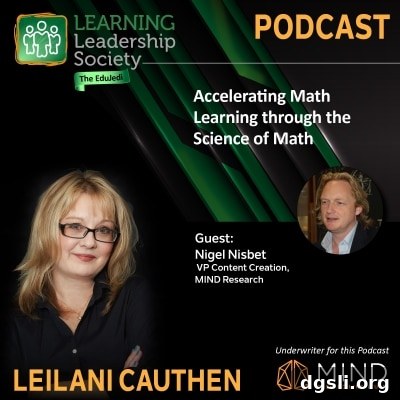
In this episode of the Learning Leadership Society Podcast, host LeiLani Cauthen interviews Nigel Nisbet, Vice President of Content Creation at the MIND Research Institute. Together they explore a powerful shift in perspective for educators and leaders: moving from the question “How should I teach?” to the more revealing question, “How do they learn?” That subtle reframing leads to more effective instructional design, clearer learning goals, and a deeper appreciation for the Science of Math—how students build mathematical understanding over time.
The conversation centers on practical, research-informed approaches that help teachers and school leaders design learning experiences around how students actually learn. Nigel Nisbet draws on his work at the MIND Research Institute to explain why focusing on learning processes—cognitive development, pattern recognition, conceptual understanding—produces stronger long-term results than simply delivering content. For educators searching for concrete strategies, the episode highlights how to translate learning science into classroom practice, curriculum design, and assessment.
Listeners will find the discussion valuable whether they work in K–12 classrooms, lead professional development, or shape district-level policy. The episode emphasizes student-centered learning, formative feedback, and the importance of sequencing tasks so students can progress from foundational ideas to more complex problem solving. By placing student learning at the center, educators can craft lessons that promote deep understanding, not only short-term performance.
Key themes include the Science of Math—how mathematical thinking develops through exploration, visualization, and connection—and the role of instructional materials and classroom interactions in supporting that development. Nigel and LeiLani examine how educators can use evidence-based practices to make math meaningful, accessible, and engaging for a wide range of learners. They discuss ways to design tasks that reveal student thinking, provide productive challenge, and support productive struggle without causing frustration.
The episode also addresses leadership implications. School and district leaders benefit from the same reframing: when decision-makers ask, “How do our students learn best?” policies and investments better align with instructional supports, professional learning, and technologies that amplify learning. Rather than defaulting to top-down mandates about teaching techniques, leaders can foster cultures of inquiry where educators experiment with approaches grounded in learning science and share results across teams.
Practical takeaways for educators include strategies for formative assessment, tips for designing sequences of learning experiences, and ideas for creating cognitively rich tasks that build conceptual fluency. The conversation encourages educators to observe and listen closely to student reasoning, use errors as learning opportunities, and prioritize tasks that promote transferable understanding. These techniques support not only mathematical skill, but also student confidence and persistence.
For anyone interested in math education, instructional design, or educational leadership, this episode offers a thoughtful synthesis of research and practice. It provides a clear rationale for shifting from a teacher-centered to a learner-centered perspective and outlines concrete steps educators and leaders can take to align curriculum, instruction, and assessment with how students learn. Whether you are an experienced teacher or a new leader, these ideas can help you improve outcomes by focusing on learning processes rather than solely on teaching procedures.
Click Here to Listen