

By LeiLani Cauthen
What lessons will we carry forward from the COVID-19 crisis, and how should education adapt? Understanding the patterns that shape institutions can help leaders make better decisions. One useful concept is the lifecycle: a rise, a period of maturity, and then decline. That arc applies to individuals, organizations, cities, and entire civilizations. Recognizing the stage an institution is in—and what new systems are emerging to replace it—helps leaders anticipate change and act strategically.
Lifecycle Pattern
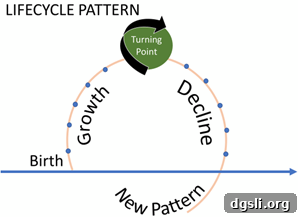
Education has followed clear historical cycles. In the 1800s, learning moved from family and church-based instruction to one-room schoolhouses, then to centralized public schooling designed for an industrial age. Schools adopted grade structures, bells, and regimented schedules that mirrored manufacturing. Over time additional bureaucratic layers—districts, service centers, and state and federal agencies—added reporting requirements and centralized control.
Around the year 2000, that centralized model reached an inflection point. Many teachers and administrators began retiring, and the heavy bureaucracy became increasingly difficult to sustain. At the same time, the consumerization of digital learning resources and the spread of computing devices on campuses accelerated disaggregation. Homeschooling, charter schools, and online learning started to gain traction, powered by improved user experiences and organizational software that reduced administrative costs.
Technology did what it has done in many industries: it enabled on-demand access to information, reducing the need for a single, centralized gatekeeper of knowledge. As families discovered that high-quality learning could be accessed directly, many began to opt out of the traditional model—for reasons that include both dissatisfaction with outcomes and a desire for greater quality of life.
Opting in to a Better Life
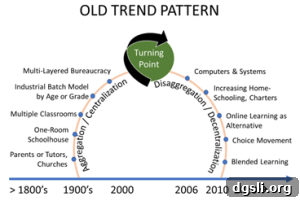
Families now often choose schooling models that prioritize flexibility, family time, and personalized pacing. In response, schools are experimenting with segmented services: one-course-a-day campus models combined with remote study, staggered drop-off times, state-required testing accommodations for homeschoolers, shared lab environments, and remote office hours for teachers. Some services—such as specialized speech pathology—are being provided via shared national infrastructure, similar to outsourcing trends in private industry.
This disaggregation is not a collapse so much as a transformation. Learning is becoming a distributed activity—less tethered to a single building and more supported by a mix of digital systems and human interventions at key moments. Technology enables this shift by delivering vast amounts of content and personalized recommendations, while humans focus on mentoring, assessment, and contexts where human connection matters most.
Personalized Workflow Learning
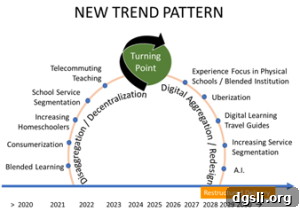
One emerging model is what the Learning Counsel calls “Personalized Workflow Learning.” This approach extends blended learning from the level of individual classrooms to the entire institution. The goal is a seamless, student-centered experience that combines digital curriculum, live instruction, and curated learning pathways so each learner follows a personalized route while still having meaningful in-person interactions.
In practice, that means mapping curriculum end-to-end and orchestrating both online and physical experiences. Early automation—decision trees and simple algorithms—can guide routine pathways, while human educators act as guides, mentors, and intervention specialists. Over time, more advanced augmented intelligence will help surface learning opportunities and suggest tailored resources, just as recommendation engines do in other industries.
We can expect new roles and services to appear: professional digital learning guides who curate personalized paths, shared resources across districts, and a variety of specialized schools that compete on reputation and niche offerings. This will increase choice and service segmentation and create new opportunities for teachers—flexible schedules, remote roles, and specialized instructional positions—while also requiring a renewed emphasis on refining direct teaching skills where human instruction is most valuable.
For education leaders, the immediate task is to begin shifting delivery incrementally—one subject, one schedule block, or one grade level at a time—while keeping long-term trends in view. The larger strategic challenge is preparing educators for a future where human skills like mentoring, assessment, facilitation of inquiry, and adaptive instruction matter most.
About the author
LeiLani Cauthen is the CEO and Publisher of The Learning Counsel. She has two decades of research, publishing, and market leadership across high tech, education, and government industries. Well versed in digital content, software development, adoption processes, and modern school coverage models, she helps define how teaching and learning will evolve in this century. She is also the author of The Consumerization of Learning.