

By Dr. Ana Gabriela Bell Jimenez
Introduction
I grew up in Costa Rica and moved to the United States as a foreign exchange student at age 20. I know firsthand what it means to learn a second language, to be an English language learner (ELL), and to develop biliteracy. Those experiences guide my work: I focus on literacy for English learners and other historically marginalized students. Early in my career as a high school English language arts teacher, I realized that although I had the credentials, the language skills, and the preparation, I did not yet have the practical tools to teach literacy in English effectively. That moment of vulnerability pushed me to pursue more deliberate, research-informed practice. Over the years I’ve studied the growing body of evidence known as the science of reading and refined strategies that help students gain the reading skills they need. In the sections that follow, I outline steps educators can take to improve literacy outcomes, grounded in that research.
Steps to Literacy Success for All Students
1. Verbalize Your Vision
Effective literacy instruction begins with a clear, personal vision. Reflect on your background, your experiences, and the outcomes you want for your students—and then say that vision out loud. While districts and systems should have strategic goals, individual educators play a decisive role in shaping daily practice. For example, my district’s vision is that every school will prepare each student to graduate ready for college, career, and community. Building from that, my personal vision is that every student—regardless of language, ethnicity, or socioeconomic status—will graduate prepared for college and career. Naming this goal focuses decisions and priorities in the classroom and beyond.
2. Create Specific, Data-Informed Goals
Once you have a vision, translate it into measurable goals. Break the vision down into concrete questions and use data to answer them: Who are my students? What does “ready for college and career” look like in terms of reading and access to grade-level texts? In my district, for example, 27 percent of students are English learners, so any meaningful literacy plan had to address their needs specifically. I also examined outcomes for African American students and students with disabilities. Defining readiness for me meant ensuring every student has access to and can understand grade-level texts. I then attached metrics to that definition and analyzed how many students already met the criteria, and how many still needed support. That backward-mapping made clear the scale and focus of the work required.
3. Align Instruction with the Science of Reading
With goals in place, evaluate your instructional practices against the research. When I analyzed my classroom and district-level data, it was clear that good intentions and traditional practices were not producing equitable achievement. That prompted a deeper engagement with the science of reading: a broad, interdisciplinary body of research that synthesizes what we know about how reading develops, why some students struggle, and which instructional approaches are most effective for most learners. As Dr. Louisa Moats explains, the science of reading is not an ideology or a single program; it is an evidence base built from thousands of studies that guides how educators can teach reading more effectively.
Understanding this research is essential to improving instruction. It helps teachers make deliberate choices about the content and sequence of instruction so that decoding, fluency, vocabulary, background knowledge, and comprehension are all systematically developed.
Key Theoretical Frameworks
The Simple View of Reading
The Simple View of Reading, proposed by Gough and Tunmer (1986), frames reading comprehension as the product of two core processes: word recognition (decoding) and language comprehension. In practice, this means that a student cannot truly understand written text unless they can both accurately decode words and make sense of language. Effective instruction addresses both strands.
The Reading Rope
Patricia Scarborough’s Reading Rope elaborates on the Simple View by identifying the subcomponents that combine to produce skilled reading. The language comprehension strand includes background knowledge, vocabulary, language structures, verbal reasoning, and knowledge of print and text. The word recognition strand includes phonological awareness, decoding skills, and sight recognition. The image below illustrates how these strands interweave over time to create fluent, strategic readers.
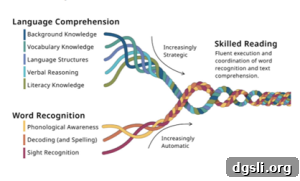
Understanding both the Simple View and the Reading Rope helps teachers plan instruction that balances systematic word-level work with rich opportunities to build oral language, background knowledge, and vocabulary. For English learners and multilingual adolescents, this balanced approach is especially important: parallel attention to decoding and to language comprehension ensures students can access increasingly complex texts while continuing to develop academic language.
Practical Next Steps for Educators
To translate research into classroom routines, start by auditing current practice against your goals: Which students are succeeding and which are not? What aspect of the Reading Rope is weakest for those students? Use assessment data that pinpoints phonological skills, decoding, fluency, vocabulary, and comprehension so you can target instruction precisely. Prioritize professional learning that builds teachers’ knowledge of the science of reading and provides coaching on practice. Finally, ensure every student has access to grade-level texts and to scaffolds that support comprehension while learners build the decoding and language skills they need.
Download your free guide to learn more and to register to see Dr. Gabi Bell at the National Literacy Summit on November 9, 2021.
About the Author
Dr. Ana Gabriela Bell Jiménez is the Director of Instruction for Literacy, Biliteracy, Arts, World Language, and Humanities at the Madison Metropolitan School District in Madison, Wisconsin. She is deeply committed to early and adolescent reading instruction for socially, culturally, and economically diverse students. Her research focuses on applying the science of reading in multilingual instructional settings. Selected publications include “Facts and Challenges Facing Bilingual Intercultural Education and Interculturalism: A Case Study of Afro-Costa Ricans” (2020) and “Education as a Vehicle for Social Transformation: Paulo Freire’s Pedagogy” (2017).