

Guest Article Written By: Mac-Z Zurawski
As a lifelong learner and educator, I am always exploring practical strategies that improve learning outcomes and clarify expectations. During my online teaching certification, I revisited an essential tool: rubrics. I had used them before as simple checklists for grading, but creating my own rubrics changed my perspective entirely. Today I see rubrics as guiding frameworks that protect instructors, support learners, and make assessments fairer and more transparent.
We have all encountered students who misread or fail to follow assignment directions. Excuses can range from “instructions weren’t clear” to “I couldn’t find the assignment details.” Attaching a clear rubric to each assignment—alongside the written instructions—reduces such misunderstandings. Rubrics can be very specific about how points are allocated or simply present a checklist of required elements. Either way, students can no longer claim they didn’t know what was expected of them.
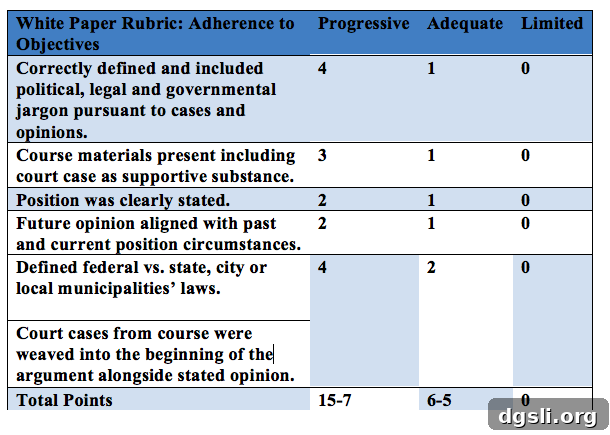
For example, I ask my students to write a one-page white paper on a current political issue. The assignment requires citing at least one court case and two course-related sources, and following accepted white paper formatting and MLA citation guidelines. The paper should include an introduction, supporting paragraphs, and a conclusion. In class, I present both the assignment directions and a detailed rubric so students clearly understand the grading criteria.
Rubric Example 1: White Paper Rubric
This rubric provides explicit guidance on the elements I expect in the white paper. Without it, students would ask more questions and might dispute grades. A well-built rubric protects both the instructor and the students by documenting expectations and standards.
Analytical vs. Holistic
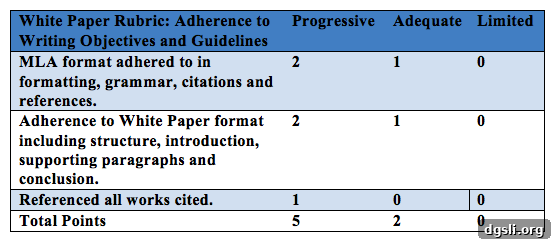
Choosing the right type of rubric depends on the assignment and the level of detail you want to provide. Analytical rubrics break an assignment into distinct criteria and specify performance levels for each criterion. They are ideal for major assignments—like research papers or projects—because they show exactly how points are earned across categories such as content, structure, evidence, and citation format. I often use multiple analytical rubrics for a single major assignment: one focused on task-specific requirements and another on writing mechanics and formatting.
Rubric Example 2: MLA Adherence Rubric
Holistic rubrics, by contrast, provide a general overall judgment rather than detailed criteria. They might note only that work was submitted on time, met basic expectations, or included a name and date. I use holistic rubrics for low-stakes assignments like reflections or participation activities where I want to communicate standards quickly and grade efficiently while still ensuring some quality control.
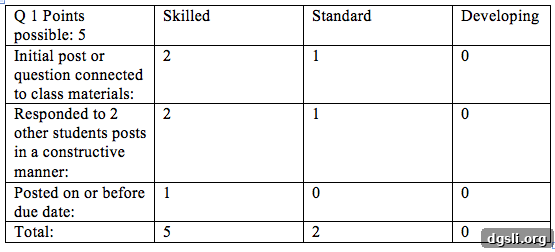
Rubric Example 3: Discussion Board Grading Rubric
A discussion board rubric typically remains simple and direct. It might reward timely posts, thoughtful contributions, and respectful engagement with peers. These rubrics make grading faster and allow me to focus more on providing meaningful feedback rather than on calculating small point differences.
Easy Tool for All
Rubrics organize the requirements and goals of an assignment in a clear, consistent way. They are easy to design using available online templates or simple tools like a table generator in a word processor. Many educators start with a basic table in Microsoft Word and customize it—adding rows for criteria, columns for performance levels, color coding, and brief descriptors. For new teachers especially, building a rubric helps clarify what matters most in an assessment and refines the instructor’s own thinking about the task.
Feedback
Rubrics also create a convenient space for targeted feedback. When designing a rubric, add a column for brief instructor comments. Highlight why a student earned a high grade or point out a specific area that needs improvement. Suggest resources or follow-up steps when a concept is misunderstood. By attaching the rubric to student work, you provide transparent rationale for grades and give learners concrete guidance for growth.
In short, rubrics are a practical, time-saving strategy that improves communication, streamlines grading, and supports student learning. Whether you choose analytical or holistic formats, investing a little time in a well-constructed rubric pays off in clearer expectations, fairer assessments, and more useful feedback.