
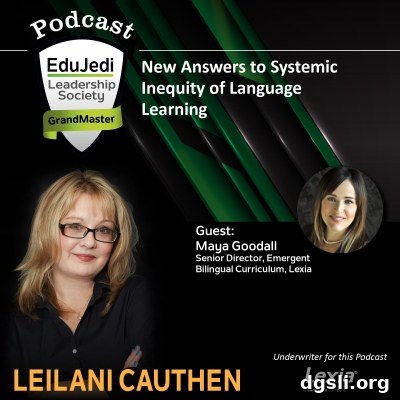
In this episode of the EduJedi Report
Traditional approaches to language instruction have often been organized around models that favor English-only delivery. Those long-standing structures can unintentionally limit access for bilingual students and create barriers for educators trying to meet diverse needs. In this episode of the EduJedi Report, host LeiLani Cauthen explores how emerging digital delivery methods are reshaping language learning—offering scaffolding that is culturally responsive, flexible, and designed to empower both learners and teachers.
Why the shift matters for bilingual learners
Language learning built into digital platforms can do more than deliver content; it can provide tailored supports that reflect students’ linguistic and cultural backgrounds. When instructional resources are designed with multilingual learners in mind, educators can leverage tools that allow for translanguaging practices, dual-language supports, and differentiated pacing. These options help students access grade-level content while continuing to develop proficiency in more than one language, without being forced into a single-language pathway.
Culturally responsive scaffolding through technology
Culturally responsive scaffolding refers to instructional design that respects and builds on learners’ cultural and linguistic assets. Digital platforms can present multiple entry points to a concept—using visuals, native-language glossaries, interactive examples, and contextual prompts—that honor students’ background knowledge. Rather than assuming one universal roadmap, these systems allow educators to select supports that align with their students’ identities and experiences, fostering engagement and deeper comprehension.
How digital tools empower educators
Teachers often face time constraints and competing demands when working to differentiate instruction. Digital learning environments can reduce some of that burden by automating routine assessments, organizing scaffolded activities, and surfacing actionable data about student progress. This allows educators to focus their professional judgment where it matters most—planning targeted interventions, facilitating small-group instruction, and reinforcing academic language—while the technology manages repetitive tasks.
Addressing individual needs more efficiently
Adaptive features in modern learning platforms can respond to individual student performance in real time, adjusting difficulty, providing additional practice, or suggesting alternative representations of content. For bilingual learners, this means that linguistic complexity and content expectation can be balanced dynamically: students receive support for comprehension without unnecessary simplification of academic standards. The result is a learning path that respects both language development and subject mastery.
Design principles to look for
When selecting or designing digital language-learning solutions, educators and decision makers should look for systems that:
- Offer multilingual resources or easy integration of native-language supports.
- Include culturally relevant content and examples that reflect learners’ lives.
- Provide flexible scaffolds—visuals, glossaries, sentence frames, and formative checks—that teachers can customize.
- Deliver meaningful, timely data that informs instruction without overwhelming practitioners.
- Support translanguaging strategies, enabling students to use all their linguistic resources.
Practical classroom implications
Integrating digitally scaffolded, culturally responsive practices doesn’t require a complete overhaul of classroom routines. Teachers can begin by incorporating multilingual glossaries, offering choice in response language for formative tasks, or using short adaptive modules for vocabulary and concept practice. Over time, these practices can create a classroom culture where linguistic diversity is an asset rather than an obstacle, and where meeting individual needs becomes more efficient and effective.
Listen to the episode
Host LeiLani Cauthen guides listeners through these themes, exploring the potential and promise of digital design in language learning, and discussing how educators can take actionable steps to support bilingual students. To hear the full conversation and learn practical strategies for implementation, listen to the episode below.
Click Here to Listen