
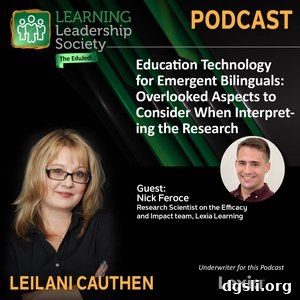
Learning Leadership Society Podcast: Research Design and Program Causality for Emergent Bilinguals
The Learning Leadership Society Podcast, hosted by Learning Counsel News Media and Research CEO LeiLani Cauthen, features an in-depth conversation with Nicholas Feroce, Ph.D., a Research Scientist at Lexia Learning. This episode focuses on research design considerations for emergent bilingual students and on how programs can demonstrate causality to produce meaningful gains for this population.
In this episode, the host and guest explore the complex landscape of evaluating educational programs intended for emergent bilingual learners. They discuss common methodological challenges, the importance of valid measurement, and how research findings should be interpreted by educators, administrators, and policymakers. The conversation emphasizes careful study design and transparent reporting to ensure research can inform practice reliably.
Topics Covered
- Key principles of research design that matter when studying emergent bilinguals, including sampling, comparison groups, and longitudinal approaches.
- The role of measurement: choosing language-appropriate assessments and culturally responsive instruments.
- How to address variability in student backgrounds—such as first language, prior schooling, and literacy development—when evaluating program effects.
- Strategies for demonstrating program causality, including randomized designs when feasible, well-matched comparison groups, and careful control of confounding factors.
- The importance of implementation fidelity and how variability in classroom practice can influence outcomes reported in research.
- How to interpret effect sizes, statistical significance, and the practical relevance of gains for emergent bilingual students.
Practical Implications for Educators and Leaders
Throughout the episode, LeiLani Cauthen and Nicholas Feroce highlight practical steps educators and district leaders can take when selecting and evaluating instructional programs for emergent bilinguals. They underscore the value of:
- Reviewing the rigor of research behind any program claim and looking for transparency about sample characteristics and study limitations.
- Confirming that assessments used in research are appropriate for students who are learning English and that progress measures reflect language development as well as content knowledge.
- Considering local context—student demographics, language profiles, and instructional models—before generalizing results from research conducted elsewhere.
- Monitoring implementation fidelity and collecting classroom-level data to ensure that a program is being used as intended and to identify barriers to success.
- Engaging stakeholders, including teachers and families, in interpreting evaluation results and in setting realistic expectations for student growth.
Why This Conversation Matters
Emergent bilingual students represent a diverse and growing portion of K–12 enrollment. High-quality research that accounts for linguistic and cultural diversity is essential for selecting instructional programs that can reliably support these learners. This episode aims to improve listeners’ ability to distinguish between strong and weak evidence, to spot common pitfalls in research interpretation, and to apply findings in ways that are equitable and effective.
Listeners will come away with a clearer understanding of what rigorous research looks like in this space and with actionable questions to ask when evaluating program claims. The episode is intended for educators, researchers, district leaders, curriculum coordinators, and anyone involved in selecting or implementing instructional supports for emergent bilingual students.
Click Here to Listen