

By Jamie Bricker
Targeted teaching focuses on preparing students to succeed by designing learning that is purposeful, practical, and personally meaningful. Instead of hoping a lesson will resonate, targeted teaching uses a layered framework that moves learners from memory to meaning to personal relevance. When these layers align, instruction becomes deeply engaging and long-lasting.
Informational Ring – Values Memory
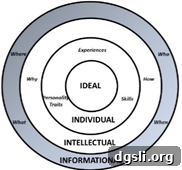
The outermost ring collects facts, terms, dates, names, and other concrete content that establish context. This informational layer answers foundational questions—who, what, when, and where—and supplies the raw material students need before they can analyze or apply ideas.
Memory-based skills—definitions, formulas, procedures—play a critical role because they fuel higher-order thinking later on. However, relying solely on drills, worksheets, and rote recall leads to short-lived learning. Overemphasis on memorization has produced generations of students who can reproduce facts on demand but struggle to use that knowledge in meaningful ways.
Teachers must strike a balance between isolated practice and contextual application. The informational ring is a necessary starting point, but it should never be treated as the final goal. Effective instruction stores facts in service of understanding and application.
Intellectual Ring – Values Meaning
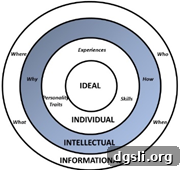
The intellectual ring shifts the focus to thinking—how and why things work. Here, students engage with inquiry, analysis, and problem solving. Rather than simply recalling answers, learners explore questions, defend reasoning, and extend their understanding through projects and discussion.
This ring requires teachers to differentiate cognitive challenge so every student has access to meaningful difficulty. Intellectual inclusiveness means providing opportunities to explain, explore, and create at an appropriate level for each learner. When classrooms encourage risk-taking and curiosity, students become active participants who want to keep learning rather than passive recipients of information.
Teachers model intellectual risk-taking as well. Authentic demonstration of thinking, exploration, and the willingness to try and fail invites students to adopt the same mindset. The intellectual ring is self-reinforcing: the more students engage in thoughtful inquiry, the more motivated they become to learn.
Individual Ring – Values Me
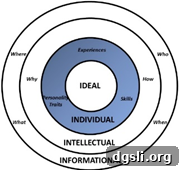
The individual ring connects learning to each student’s unique background, interests, and experiences—what researchers call schema. Students learn either because they have external incentives (grades, compliance) or because they feel a personal connection to the work. Tasks that align with a learner’s passions and identity are far more likely to spark sustained motivation.
To reduce inequities, teachers should provide common classroom experiences that broaden every student’s schema. Field trips, guest speakers, virtual expeditions, and shared projects help level the playing field for learners who may lack certain life experiences. Schools should actively reduce experiential gaps caused by socioeconomic differences so all students can access meaningful contexts for learning.
Recognizing and leveraging individual schema validates students’ identities and helps them see why their learning matters. True educational success is measured by the long-term impact on learners—the ways their knowledge and confidence grow—not only by short-term scores.
Ideal Ring
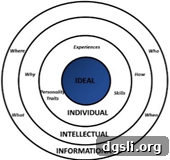
The ideal ring represents the alignment of the informational, intellectual, and individual rings. In practice, this looks like a foundation of accurate, purposeful facts supporting thought-provoking questions that resonate with individual students. When all three elements work together, learning becomes both challenging and deeply rewarding.
Although this alignment may seem aspirational, it should remain the target for every lesson. Striving for this balance fosters lifelong learners who adopt a growth mindset—students who view challenge as opportunity and persist in pursuit of understanding.
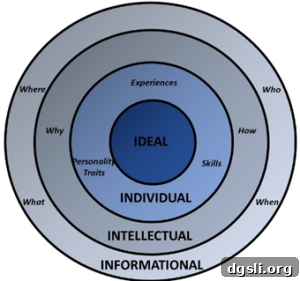
As instruction moves from the outer ring inward, student engagement typically progresses from explanation to exploration to exhilaration. Each ring is essential and they work best in sequence: facts inform thinking, thinking connects with the learner, and the learner then makes knowledge meaningful and memorable. Targeted teaching aims to make learning matter, preparing students to shape the future rather than simply recite the past.
About the Author
Jamie Bricker was a long-time elementary school administrator and teacher near Toronto, Ontario. He now works as an international educational writer and speaker and continues to write about effective classroom practice.
This article was originally published by The Learning Counsel, a research institute and news media hub focused on the shift to digital curriculum in education.