By Betsy Hill and Roger Stark
Why Academic Performance Still Matters
As educators and parents ask what matters most for students’ futures, one question keeps surfacing: is academic performance truly important, and if so, why? At first glance the answer seems obvious—yes. But to be useful, that answer should explain what academic achievement actually opens up for a young person.
Academic performance opens doors. Strong achievement expands opportunity: access to higher education, professional programs, better first jobs, economic mobility and greater life choices. Conversely, poor academic performance often shuts doors, sometimes permanently. Equity—equal access to opportunity—becomes far harder to achieve when students lack the academic foundation they need.
What Academic Achievement Really Reflects
High academic achievement is not only knowledge. It’s the product of cognitive capacity, motivation, and persistence. Not every student shares the same interests, sees the same relevance in school tasks, or values grades the same way. In earlier decades, before the internet and the abundance of alternative paths, educational authority and societal roles were simpler and more prescriptive. Today, students face many more choices and distractions, and maintaining the desire to pursue high academic standards requires both capacity and support.
When students become disengaged or encounter learning difficulties, motivation often erodes. Research has long shown that low academic achievement can undermine self-esteem, reduce goal attainment, and limit both academic and economic success. Employers frequently use grades and credentials as a basic screening tool: a poor transcript can block entry into meaningful career pathways. Economic data referenced by the Social Security Administration reinforces that credentialing matters—on average, college graduates earn substantially more over a lifetime than high school graduates, and individuals with advanced degrees earn even more.
What Drives Academic Success: Cognitive Capacity
Studies indicate that roughly half of the variation in academic achievement is explained by a student’s cognitive capacity. The encouraging part is that cognitive skills are, to a meaningful degree, trainable and improvable. Strengthening these core processes—attention, memory, perceptual processing and executive functions—creates what we call cognitive literacy.
Cognitive literacy is the toolbox that enables learning: the ability to focus, hold and manipulate information, see patterns, switch strategies, and plan approaches to tasks. In a rapidly changing world, students can’t rely on memorizing fixed procedures. They need cognitive flexibility to learn new skills repeatedly, adapt to new roles, and solve novel problems. Every student should know their cognitive strengths and weaknesses and have access to personalized strategies and supports to build capacity.
Cognitive Skills Underpinning Reading
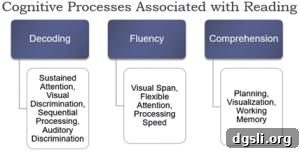
Reading depends on many coordinated cognitive processes. Decoding, fluency and comprehension all rely on more basic skills working together efficiently:
- Sustained Attention – Staying focused while reading so words and phrases aren’t missed.
- Sequential Processing – Keeping letters and words in the correct order for accurate decoding.
- Visual Discrimination – Quickly distinguishing similar letters (e.g., b vs. p) during reading.
- Auditory Discrimination – Hearing sound differences that map to written representations.
Fluency depends on repeated practice and additional processes:
- Visual Span – How much text can be absorbed at a glance, affecting whether a reader decodes word-by-word or takes in larger chunks.
- Flexible Attention – Smoothly shifting between decoding and recognizing sight words and moving across lines or paragraphs.
- Processing Speed – The pace at which decoded information can be understood and integrated.
Comprehension is the ultimate purpose of reading but often remains challenging even for fluent decoders. Key cognitive contributors to comprehension include:
- Working Memory – Holding and manipulating information while connecting it to prior knowledge to build meaning.
- Visualization – Creating mental images or mind maps to strengthen memory and understanding.
- Planning – Choosing the right reading strategy—skimming for gist, searching for specific details, or reading deeply for complex understanding.
How Cognitive Skills Support Math
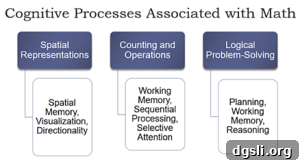
Research consistently links math success to visual-spatial and executive skills. As math problems become more complex, the reliance on spatial reasoning and visualization grows. Important visual-spatial skills include:
- Spatial Memory – Remembering positions and relationships in space, which undergirds problem solving.
- Visualization – Mentally manipulating shapes and transformations, critical for geometry and advanced problem solving.
- Directionality – Knowing left from right and orienting objects correctly, which affects navigation, map reading and STEM tasks.
Counting and numerical operations also draw heavily on cognitive functions:
- Working Memory – Keeping track of intermediate results and relationships while solving problems.
- Sequential Processing – Following ordered steps, such as the order of operations in algebra.
- Selective Attention – Filtering irrelevant details from complex word problems to focus on the essential facts.
The Case for Integrated Cognitive Training
When learners struggle, curriculum and instruction alone are not always the root cause. Learner variability—different cognitive strengths and weaknesses—means many students need targeted cognitive supports. Comprehensive, integrated cognitive training builds the underlying capacities that make academic learning possible. By improving attention, working memory, processing speed and other executive functions, students gain the foundation needed to benefit from instruction and to persevere in learning.
Strengthening cognitive literacy not only improves academic outcomes but also supports mental and emotional wellbeing. Students who can meet academic demands are less likely to develop the sustained stress and low self-esteem that often accompany persistent failure. When cognitive training opens pathways to success, both students and their families typically experience improved emotional health, contributing to long-term social equity.
About the Authors
Betsy Hill is President of BrainWare Learning Company, a firm that applies neuroscience to expand learning capacity. An experienced educator, she has studied neuroscience and education with experts including Dr. Patricia Wolfe. Betsy is a former chair of the board at Chicago State University, teaches strategic thinking in the MBA program at Lake Forest Graduate School of Management, and holds an MAT and an MBA from Northwestern University.
Roger Stark is Co-founder and CEO of BrainWare Learning Company. For more than a decade he has worked to make cognitive literacy training and assessment widely available. He led the development of BrainWare SAFARI, a researched, online cognitive training system designed to strengthen the cognitive skills that support learning.
This article was originally published by The Learning Counsel, a research institute and news media hub focused on the shift to digital curriculum in education.