
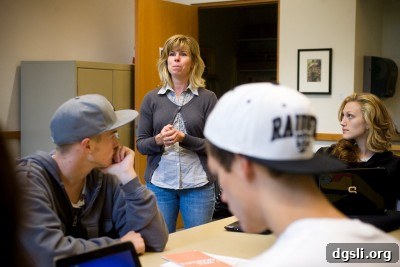
Guest article by Deborah O’Brien, Principal of The American Academy’s NoDropouts
At first glance, it might seem like everything about education has changed. In some respects, that’s true. Yet the core of what we do as educators remains the same: supporting learning, guiding students and building relationships that help young people succeed.
For two decades as a public school principal at the elementary, middle and high school levels, my mornings began long before most people arrived. I’d pull into an empty parking lot, walk into a dark building and stroll the hallways as the day began. These walks let me take the pulse of the school: Were students engaged and ready to learn? Were teachers confident and prepared? Some principals choose to manage from an office; for me, being visible among students, teachers, parents and staff was essential. Those human connections shaped the culture and success of the school.
Today, my routine looks different on the surface. I still rise early, but I no longer commute to a brick-and-mortar building. Instead I sit at a home office desk, open my laptop and reach out by phone, email and text. I review student progress reports, respond to teacher updates and connect with families. I monitor online work, coordinate mentors and advocate for students who need local support. In this virtual environment, I’ve learned to “walk the halls” through screens, messages and frequent, intentional contact.
When I left the Ritzville School District to lead an online high school focused on serving former dropouts and other at-risk students nationwide, I expected major changes. Two years later, I’m struck by the continuity: while the hallways are different, the responsibilities of leadership remain the same. I still coach and support teachers, address behavioral and academic barriers, and partner with parents and community resources to meet students’ needs.
Many people picture a school as a physical building with rows of desks and a teacher at the front. That traditional model has served millions of students well and continues to be effective for many learners. However, over the last decade, educational options have evolved to better meet diverse needs. Online schools, blended learning, mentorship programs and targeted dropout recovery initiatives offer flexibility that traditional classrooms sometimes cannot provide.
It’s natural for educators to view change with caution. Wise skepticism protects quality. But caution should not become reflexive resistance. When thoughtfully designed and properly supported, online learning and dropout recovery models can be powerful tools for student success.
Students in our program often face challenges that make traditional school attendance difficult. Some are young parents juggling childcare and work. Others hold full-time jobs, manage chronic health conditions, or cope with bullying, gang involvement or other safety concerns. Many have learning differences or mental health needs that the standard school day does not accommodate. For these learners, accredited online courses paired with personalized mentorship and local advocacy create pathways back to graduation.
Our model centers on three elements: flexible online curriculum, one-on-one mentoring, and community-based support. The online courses provide accredited, standards-aligned instruction students can access on their own schedules. Mentors build relationships, set goals, monitor progress and keep students accountable. Local advocates—teachers, counselors or community partners—step in when students need face-to-face assistance or access to services. Together, these components form a dropout recovery strategy that respects each student’s circumstances while maintaining rigorous expectations.
I am proud of the successes we’ve seen. In many cases, the physical distance between students and school staff, which once felt like a drawback, has become a strength. Students who have been repeatedly disappointed by adults often appreciate the control and privacy that virtual learning provides. They decide when and how to engage, and many respond to that agency with renewed commitment. The accountability we require—regular check-ins, deadlines and mentor support—helps them translate that commitment into measurable progress.
There are no universal solutions in education, but expanding options is a moral imperative. Offering high-quality online learning, strong mentorship and local advocacy creates a safety net for students at risk of falling through the cracks. It extends the reach of public education to those whose lives prevent them from thriving in a conventional setting.
At its heart, the work hasn’t changed: we are still guiding young people, fostering learning and striving for equity. Each day, as I check progress dashboards, talk with teachers, and message students, I feel the same satisfaction I felt walking physical hallways years ago. Leadership in an online high school demands new tools and new practices, but it demands the same commitment to relationships, accountability and high expectations.
Deborah O’Brien is the principal of The American Academy’s NoDropouts program, which collaborates with school districts nationwide to provide at-risk students a second chance to complete their education. For information about the NoDropouts program, search NoDropouts.com.