


By Betsy Hill and Roger Stark
Editor’s Note: This is Part 3 in a five-part series.
In the first article of this series we argued that one of the clearest equity issues in our schools is cognitive capacity — the mental skills students bring to learning. Solving this requires three things:
- Accurately assessing each student’s cognitive strengths and weaknesses;
- Remediating and strengthening weaker cognitive processes while developing those already strong; and
- Designing learning environments — instruction, curriculum and technology — grounded in science rather than folklore.
The second article focused on the first task: how to identify individual cognitive profiles and why that matters. Cognitive skills explain a substantial portion of the variation in academic performance — often more than factors like teacher quality or instructional time. Once we know where a student’s cognitive profile falls short, the next and crucial step is remediation.
Remediation of cognitive skills is not the usual response in schools. Often teachers assume lack of progress is purely instructional and respond by reteaching content repeatedly. When cognitive weaknesses are known — for example through an evaluation that results in an IEP or 504 plan — schools commonly offer accommodations, curriculum adjustments, and compensatory strategies. Typical examples include:
- Accommodations: extra time on tests, verbal as well as written instructions, or an aide to help with note-taking;
- Curriculum adjustments: simplified assignments, fewer spelling words, or reading material at a lower Lexile level;
- Compensatory strategies: frequent breaks, repetition of information, or external memory aids.
Those traditional approaches are valuable because they help students access learning in the short term, but they do not remediate the underlying cognitive limitations. To achieve true equity of access, we must improve a student’s cognitive capacity itself.
Comprehensive, integrated cognitive training does precisely that. It systematically exercises the brain processes involved in taking in, organizing, storing, retrieving and applying information. When the training is well-designed and evidence-based, it can measurably improve core cognitive skills — including processing speed, working memory and executive functions — to a greater extent than many educators expect.
Research demonstrates the power of targeted cognitive training. In randomized studies of students with Specific Learning Disabilities (SLD), all participants continued to receive standard reading and math interventions, but a randomly assigned treatment group also completed cognitive training sessions three to five times per week, 30 to 45 minutes each, over 12 weeks. Pre- and post-testing with standardized cognitive batteries and achievement tests revealed no significant cognitive change in the no-treatment group, while the treatment group closed much of the cognitive gap with typically developing peers. Importantly, these cognitive gains translated into accelerated academic growth: over 12 weeks the treatment students averaged about 0.8 grade equivalents in reading and 1.0 grade equivalents in math.
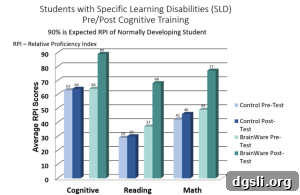
“Effect of Neuroscience-Based Cognitive Skill Training on Growth of Cognitive Deficits Associated with Learning Disabilities …” Sarah Abitbol Avtzon. Learning Disabilities: A Multidisciplinary Journal. 2012
Multiple studies have reported accelerated academic gains for students on IEPs who received cognitive training. The experience is clear in classroom stories as well. In one study, a student named Rocky, who typically earned Cs and Ds in science, began a cognitive training program three times per week for 45 minutes. Weeks later Rocky earned an A. When his teacher, Mr. Sanders, visited the training lab to learn more, Rocky explained that he had started taking notes — and more importantly, that he could now take notes while following the teacher. Mr. Sanders knew he hadn’t slowed his instruction; Rocky’s processing speed, working memory and ability to retain information at classroom pace had improved.
Remediation through cognitive training is not limited to students with diagnosed learning disabilities. It can also help students from low socioeconomic backgrounds, a population that often shows persistent achievement gaps. For example, students in three high-poverty South Carolina schools improved their Cognitive Abilities Test (CogAT) scores after 12 weeks of cognitive training. Those gains changed predicted academic outcomes and increased the number of students qualifying for the district Gifted program, where previously none had qualified.
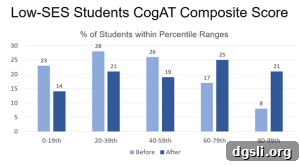
Broad-Based Improvement of Cognitive Skills
It may seem surprising that general cognitive training affects subject-specific outcomes like reading and math, but students bring a single brain to every learning task. Cognitive skills underpin reading, math, social-emotional competence, athletics and daily life. Strengthening core mental capacities gives students greater ability to engage with content across domains.
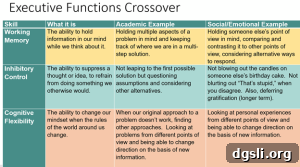
Executive functions are often thought of as self-regulation, but that description understates their academic role. Executive functions include skills such as goal-directed planning, maintaining focus, shifting attention, and updating working memory — all essential to successful learning. The examples illustrated in the series’ charts show how these skills map directly to classroom tasks.
In our hurry to help students catch up in reading or math, we sometimes treat content as the only missing piece. By contrast, athletes routinely train underlying capacities — strength, flexibility, stamina — to perform better. Students require an equivalent: systematic training of cognitive capacities so they can fully access the learning experiences schools provide.
When schools invest in building students’ cognitive capacity, they reduce the need to work around weaknesses and instead give students direct access to the curriculum. In the next installment of this series we will explore how learning experiences — instruction, curriculum design and technology — can be constructed to further promote equity of access.
About the authors
Betsy Hill is President of BrainWare Learning Company, which applies neuroscience to build learning capacity. An experienced educator, she has studied neuroscience and education with experts including Dr. Patricia Wolfe, former chair of the board of trustees at Chicago State University, and she teaches strategic thinking in the MBA program at Lake Forest Graduate School of Management. She holds a Master of Arts in Teaching and an MBA from Northwestern University.
Roger Stark is Co-founder and CEO of BrainWare Learning Company. Over the last decade he has led efforts to make comprehensive cognitive literacy training and assessment accessible, drawing on decades of clinical collaboration. He also led development of BrainWare SAFARI, a widely researched online cognitive training tool.
This article was originally published by The Learning Counsel, a research institute and news media hub focused on the shift to digital curriculum in education.