
By Howie Templer
Welcome to the first post in a series of hands-on math projects designed for elementary classrooms. These activities are low-cost, easy to set up, and built to engage students with meaningful, playful math. Each post will feature three classroom-ready projects grouped around a common theme. Every activity shared here has been classroom-tested for both fun and learning—what I call FQ (Fun Quotient) and SML (Sneaky Math Learning).
Math becomes memorable when it connects to purpose and play rather than rote memorization. In this installment—Candy Calculations—students apply key math concepts through candy-based projects. The three activities use place value, multiplication and proportional reasoning, and perimeter and area. They invite creativity, experimentation, and opportunities to make and learn from mistakes. Below you’ll find clear overviews, learning goals, materials, and simple ideas for running each project in your classroom.
Code Breaker: Jelly Bean Mosaics (Place Value & Base 10)
Objective: Help students understand place value within the Base 10 system through a creative coding and art activity.
Overview: Students create mosaic designs using at least four different colored jelly beans. Each color represents a different place value (for example, ones, tens, hundreds, and thousands). After building their mosaics—flowers, faces, sports scenes, or abstract patterns—students encode a hidden number into their design. Classmates try to decode the number by interpreting the colors as place-value units.
Materials: Jelly beans in at least four colors, paper grid or shallow trays, pencils and paper for recording codes.
Math skills targeted: Place value concept development, grouping, composing and decomposing numbers, and written explanation of reasoning.
Classroom tips: Provide a simple legend that links colors to place values to start, then encourage students to create their own legends for extension. Use grid paper to help students plan mosaics and to make counting easier. Offer opportunities for paired or small-group decoding challenges so students explain their thinking aloud.
Licorice Strength Analysis (Multiplication & Proportional Thinking)
Objective: Explore multiplication and proportional reasoning by measuring how many licorice strands are needed to support various weights.
Overview: Students test the tensile strength of single licorice strands, then test bundles of multiple strands. They collect data, look for patterns, and use multiplication and proportional reasoning to predict how many strands would be required to support a chosen weight—first a single student, then as an extension larger groups or imaginative challenges.
Materials: Licorice strands (strawberry or other preferred flavors), small weights or classroom-safe objects, a secure hook or clamp for suspending weight, scale for measuring test weights (optional), data recording sheets.
Math skills targeted: Multiplication as repeated addition, ratio and proportional thinking, data collection and interpretation, estimation and prediction.
Classroom tips: Emphasize safety and hygiene—use new or individually handled licorice pieces and avoid sharing eaten pieces. Allow students to design testing methods and discuss variables (strand length, knotting, attachment method). Encourage written predictions and reflection: Did the data match expectations? What factors affected results?
Extension ideas: Pose larger-scale hypotheticals for persuasive writing or math arguments—How many strands would be needed to suspend the class? To “hold” a textbook? These challenges build proportional reasoning without requiring actual risky demonstrations.
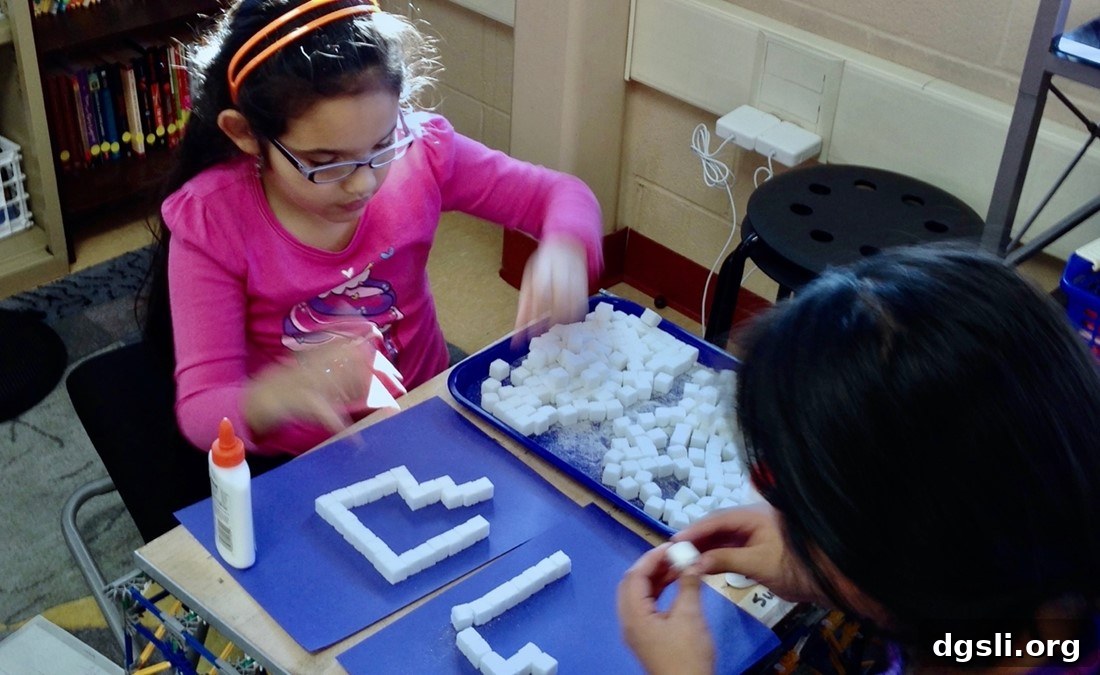
Sugar Cube City (Perimeter & Area)
Objective: Teach perimeter, area, and scale modeling while students design and build a small “city” from sugar cubes.
Overview: Working from a simple blueprint or self-made plan, students place sugar cubes to define building footprints, calculate perimeters for road and fence layouts, and compute area for each lot or building. Once comfortable with single structures, groups connect buildings into a neighborhood or city layout that follows rules for spacing and scale.
Materials: Sugar cubes, baseboards or laminated grid paper, rulers, graph paper, pencils, colored markers for labeling.
Math skills targeted: Measuring and calculating perimeter and area, using grid-based scale models, spatial reasoning, planning and collaborative problem-solving.
Classroom tips: Start with a single house blueprint so students can practice perimeter and area calculations on a small scale. Then expand to multi-building layouts and communal spaces (parks, schools). Consider cross-curricular extensions with social studies or storytelling: name streets or plan a school route for a walking field trip.
All three projects require minimal materials and can be adapted to different grade levels by adjusting complexity and vocabulary. They foster creativity, communication, and mathematical reasoning in ways that make learning feel purposeful and fun. Allow time for experimentation and encourage students to record methods, measurements, and reflections—these metacognitive steps consolidate understanding.
Practical note: Licorice testing can be part of the fun, but consider using strands that won’t cause problems for students with allergies or dietary restrictions. If in doubt, substitute safe alternatives with similar properties (colored string or craft cord) for the strength tests.
If you try these activities, gather student work samples and notes about the learning outcomes. Small adjustments—different place-value groupings, varied weight sets, or scaled city plans—make the projects reusable across multiple grade levels. Downloadable lesson templates and printable materials can save prep time, and simple rubrics help assess math reasoning, collaboration, and communication.
About the author
Howie Templer is the Chief Project Designer at 10storymath, a Chicago-based developer of project-based math supplements for elementary schools. He taught in the Chicago area for 12 years, specializing in integrating project-based learning into core curricula. He is a recipient of the Golden Apple Award and was a 2018 finalist for the Presidential Award for Excellence in Math & Science Teaching.
For classroom questions or to share how these activities went with your students, contact: howie [at] 10storymath.com.