
U.S. Wins Math Olympiad For the Second Consecutive Year
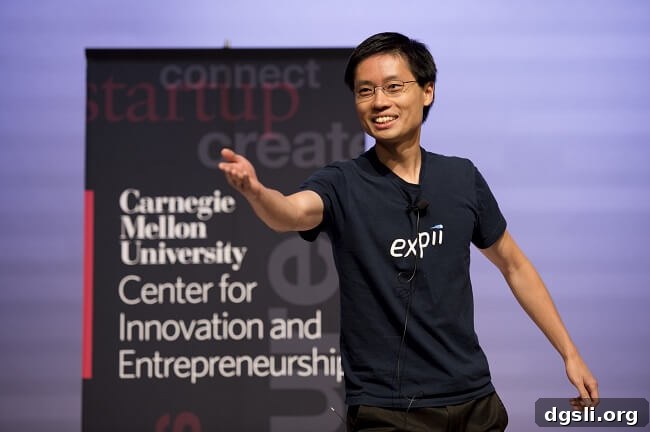
Meet Po‑Shen Loh, a professor at Carnegie Mellon University and the head coach of Team USA, who helped lead the United States to win the International Mathematical Olympiad for a second straight year. He now extends his impact on math education through a new offering, Expii Solve.
Po, can you tell us about your background? As a child, was math your favorite subject?
I was born in California and raised in Madison, Wisconsin, where I attended public school. Math appealed to me because mistakes were an opportunity to trace an error and improve. I enjoyed continuous challenges and the satisfaction of solving progressively harder problems. In middle school I discovered MATHCOUNTS, which led me to national competitions and ultimately to third place in the country in 1996. In high school I continued with contests organized by the Mathematical Association of America, which earned me a spot on the U.S. IMO team in 1999. Later, in college and graduate school, I developed a deeper appreciation for mathematical theory, which shapes my work today.
This is your second year leading a winning IMO team. What is the competition and what does a U.S. win mean internationally?
The International Mathematical Olympiad (IMO) is the premier global math contest for pre‑college students. Each country sends six students who face six very challenging problems over two exam days (nine total hours). Problems require original proofs and creative reasoning rather than routine application of formulas. Team rankings come from the sum of individual scores.
The United States’ consecutive wins show the success of a distinctive approach to training. Instead of focusing narrowly on IMO-style problems, the U.S. national camp emphasizes broad mathematical thinking and context. Trainers—often former Olympians from various countries—connect high school contest material to post‑secondary topics. The camp is deliberately collaborative and non‑competitive: team selection occurs before the camp, and international guest students are invited free of charge. In 2016, ten of the 44 IMO gold medalists had participated in the U.S. program. Next year the program plans to host 30 international guests, making it one of the largest internationalized Olympiad training initiatives.
That strategy may seem counterintuitive at first, but the results demonstrate the value of investing in long‑term development and a collaborative learning environment.
You describe math not just as arithmetic but as a way of understanding the world. Can you expand on that?
Mathematics is the disciplined art of creative thinking and problem solving in objective contexts. It provides a logical framework to move from basic understanding to deeper insight—especially when intuition is misleading. For example, consider the classic martini glass puzzle that asks which glass is half full. A majority choose by height, but that answer is wrong; math reveals the correct reasoning. In that sense, math functions like a courtroom of ideas: it requires and provides rigorous justification. School curricula often teach celebrated formulas, but the goal should be to understand why those facts are true so students can develop their own original deductions to meet future challenges.
Tell us about Expii Solve. Why did you create it, how does it work, and who benefits from it?
When I became national coach, I wanted to raise the mathematical baseline nationwide, not only train elite students. With a background in technology, I launched Expii, a platform offering free personalized learning that adapts dynamically to each learner’s goals. Expii Solve is a curated branch of the site: every week I publish five math challenges that range from surprising and accessible to seriously difficult. I select topics by reflecting on subjects of broad interest—this week’s set, for example, ties to the Olympics—and present puzzles ordered by difficulty. The first problems are within reach of advanced middle school students but often surprise adults; the final problems are aimed at contest solvers. Expii Solve is useful for middle and high school students, educators, and anyone curious about why math matters.
I travel frequently giving talks to students, but those events reach only small audiences. Expii lets me scale those talks globally. We also partnered with the film The Man Who Knew Infinity to run the Spirit of Ramanujan Talent Search on expii.com/ramanujan, using puzzles delivered to smartphones to discover talent worldwide.
Questions from teaching colleagues:
Which parts of the math curriculum should be removed because they’re no longer effective? For example, do we still need long division?
I believe we should augment rather than remove content. The core problem is not specific topics but lack of personalization: one teacher for 30 students means many fall behind. Math concepts form long prerequisite chains—missing one link makes future material hard to grasp. Personalized, free learning (like Expii) can let students progress at their own pace, reducing the need to cut topics and instead allowing us to add material that cultivates deeper understanding and creativity.
How do students on the team develop a “math identity”? Many students say, “We hate math because it’s too difficult!” When do they realize they are mathematicians?
Each student’s journey is different. Team members often say they love math because beautiful, elegant solutions are thrilling. Many recognized their inclination early, but it’s never too late: a few years of focused effort can make someone exceptional. Parents can help by exploring challenging puzzles with their children—shared curiosity drives engagement and growth.
Math keeps changing and parents often can’t help with homework. How should teachers, parents, and students handle this evolving landscape?
Routine homework builds standard skills, but creative puzzles develop problem solving and mathematical thinking. Sources like brainteaser collections, MAA competition problems, and online creative problem sets (such as Expii Solve) offer engaging challenges that build both skills and creativity. Working on non‑standard problems is analogous to project‑based learning in science: students acquire foundational techniques naturally while developing deeper insight. When students learn this way, routine homework becomes much easier. Emphasizing conceptual understanding over rote technique—an aim shared by Common Core—will improve outcomes.
What advice would you give an 8th grader struggling to retain math concepts?
Try interesting, low‑pressure mathematical challenges that spark curiosity. The stakes are low and the reward is intrinsic: the satisfaction of solving something surprising. These problems build concepts at a comfortable pace and make formal coursework far easier later. Working through puzzles with no fear of grades helps build a strong, lasting mathematical foundation.
For more information, see Po‑Shen Loh’s profile on Remake Learning.