
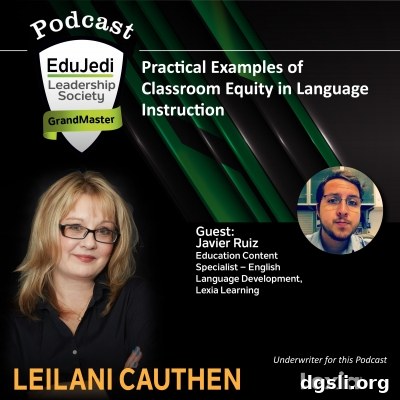
Entering the education system as an emergent bilingual brings a wide range of experiences and needs that demand thoughtful, equity-centered responses. In this episode of The EduJedi Report, host LeiLani Cauthen speaks with Javier Ruiz, Education Content Specialist for English Language Development at Lexia Learning, about how growing awareness of equity is reshaping the ways schools serve emergent bilingual students (often referred to in the past as English Language Learners). Their conversation centers on culturally responsive approaches to instruction, the importance of recognizing multiple accents and dialects, and strategies that help students connect their linguistic identities to academic success.
Educators and school leaders are increasingly attentive to the ways classroom practices either support or undermine equitable learning opportunities. In this episode, the discussion emphasizes the need to move beyond a narrow focus on standardized language norms and instead honor the linguistic diversity students bring to school. Recognizing accents, dialects, and home languages as assets—rather than deficits—creates a more inclusive learning environment and supports positive student identity and engagement.
The conversation highlights practical considerations for English Language Development (ELD) instruction. Javier Ruiz and LeiLani Cauthen talk about classroom strategies that blend high-quality language instruction with culturally relevant content. These approaches can include validating students’ home languages during classroom interactions, offering scaffolds that bridge to academic English, and designing assessments that fairly represent students’ abilities without penalizing them for dialectal differences. The goal is to ensure that emergent bilinguals have access to rigorous learning while also feeling seen and respected for who they are.
Another key theme is the value of multiple perspectives in learning materials and teacher training. When curricula reflect a range of cultural backgrounds and linguistic patterns, students are more likely to see themselves in the content and to engage deeply. Teacher preparation and ongoing professional learning play an essential role in equipping educators to respond to linguistic diversity with competence and care. Ruiz and Cauthen discuss the importance of practical tools and professional conversations that help teachers recognize bias, adapt instruction, and build strong relationships with students and families.
Assessment and progress monitoring are also addressed with an equity lens. Accurate evaluation of language development should distinguish between language learning that is part of acquiring academic English and gaps that indicate a need for additional instructional support. Thoughtful use of formative assessment, portfolio work, and performance-based tasks can provide a fuller picture of a student’s abilities and growth without relying solely on one-size-fits-all standardized measures.
Finally, the episode underscores the impact of classroom culture on learner self-identification. When students hear varied accents and see multiple dialects represented and respected in school, they gain confidence to participate, take risks, and pursue learning goals. Encouraging classroom practices that celebrate linguistic diversity—such as bilingual peer collaboration, culturally responsive reading choices, and opportunities for students to share their language backgrounds—helps foster stronger academic and social outcomes.
For educators, administrators, and anyone invested in equitable education, this episode of The EduJedi Report offers a thoughtful, practical conversation about serving emergent bilingual students in ways that honor both language development and cultural identity. The dialogue between LeiLani Cauthen and Javier Ruiz provides ideas and direction for classroom practice, curriculum design, and professional learning that center equity and language diversity.
Click Here to Listen