
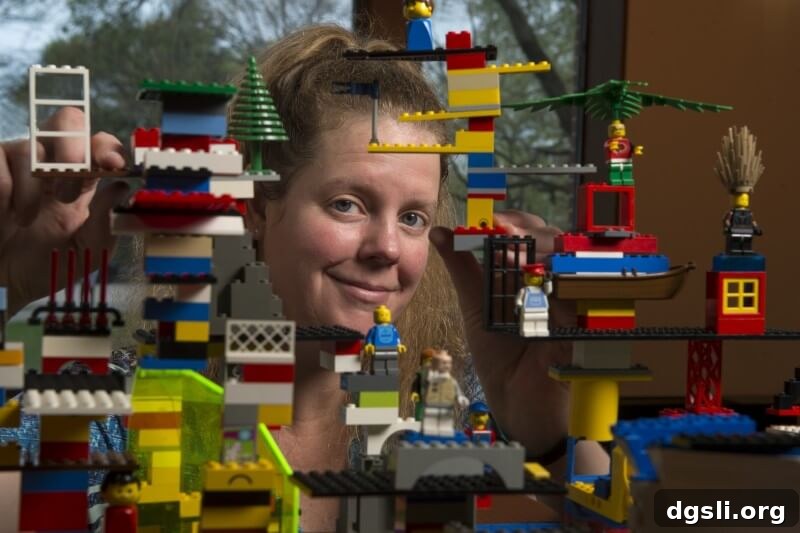
Megan Lotts Is Redefining the Role of Libraries—One Lego Brick at a Time
Shared with permission, By Patti Verbanas/Rutgers Today
Megan Lotts is changing how people think about libraries. Far from the stereotype of a quiet, “shushing” librarian, Lotts has embraced hands-on learning and social interaction by installing a Lego Playing Station in the heart of Rutgers University’s Art Library. Surrounded by nearly 300 pounds of colorful bricks, she fosters creativity, conversation and collaborative problem-solving.
Lotts views Legos as a universal, three-dimensional language that sparks imagination and promotes critical thinking. She has watched artists and scientists sit together at the table, strike up conversations and realize they share similar interests and approaches. The Lego station encourages teamwork, visual storytelling and experiential learning—activities that complement traditional book-based study and expand the library’s educational role.
Since installing the station in 2014, Lotts has used it to host events, contests, workshops and class activities. Programming has included Block Parties, a “Create Your Ideal Lego Library” challenge and guided problem-solving sessions for academic groups. One memorable moment came when Lotts and two Russian visitors who spoke no common language nevertheless collaborated, built and enjoyed the shared experience—an example of community building at its best.
As a visual artist, Lotts photographs creations at the station and has documented more than 650 images of models built by students and visitors. She sees the constructions as narrative expressions—small stories that reveal participants’ imaginations, interests and problem-solving approaches. The visual record reinforces the station’s value as both an artistic and educational resource.
The station has also attracted families and younger visitors to the Art Library. Parents frequently ask if they can reserve the space for birthday parties and bring children to play and learn. Lotts points out that welcoming families into an academic library builds long-term relationships; these young visitors may grow into future students and supporters of the institution.
Lotts has actively shared her approach beyond Rutgers. Last fall she packed a 100-pound load of Lego materials and drove 6,000 miles through seven states, presenting workshops at 20 academic libraries, including fellow Big Ten institutions such as Pennsylvania State University, Indiana University, Ohio State and the University of Maryland. Her presentations adapt the Lego Serious Play method for higher education, guiding participants through questions they answer by constructing models. The emphasis is learning by doing—participants begin quietly, then break into energetic conversation as they select pieces, share ideas and build collaboratively. That creative momentum often leads to fresh ways of tackling academic problems.
When librarians inquire about noise, clutter, space or costs, Lotts offers practical solutions and clear educational rationale. She acknowledges that Lego play can be noisy and messy—bins can tip and bricks can scatter—but she frames that energy as productive: movement and conversation are central to makerspace learning. To address concerns, she posts signs that outline the station’s learning objectives, demonstrates low-cost setup options, and highlights compact footprints for makerspaces.
Lotts also emphasizes affordability and resourcefulness. The Rutgers Art Library station began with more than 150 pounds of rescued Lego pieces obtained from a commercial junk removal company, and additional donations from alumni and library staff brought the total to roughly 275 pounds. Such creative sourcing shows that institutions can introduce interactive learning without prohibitive expense.
For Lotts, the goal is clear: make the library a place where people come to explore, collaborate and be inspired. “Libraries are grand places, but the challenge is to get people to walk in and explore when there’s so much cool stuff going on elsewhere,” she explains. Her Lego station serves as a visible, inviting “flash” that draws people inside and signals that the library supports informal learning, community engagement and creative experimentation. Having earned the playful moniker “the Lego Librarian,” Lotts considers that a sign of success and a promising model for how libraries can stay relevant in a changing educational landscape.
Portrait Photo: Nick Romanenko/Rutgers University