
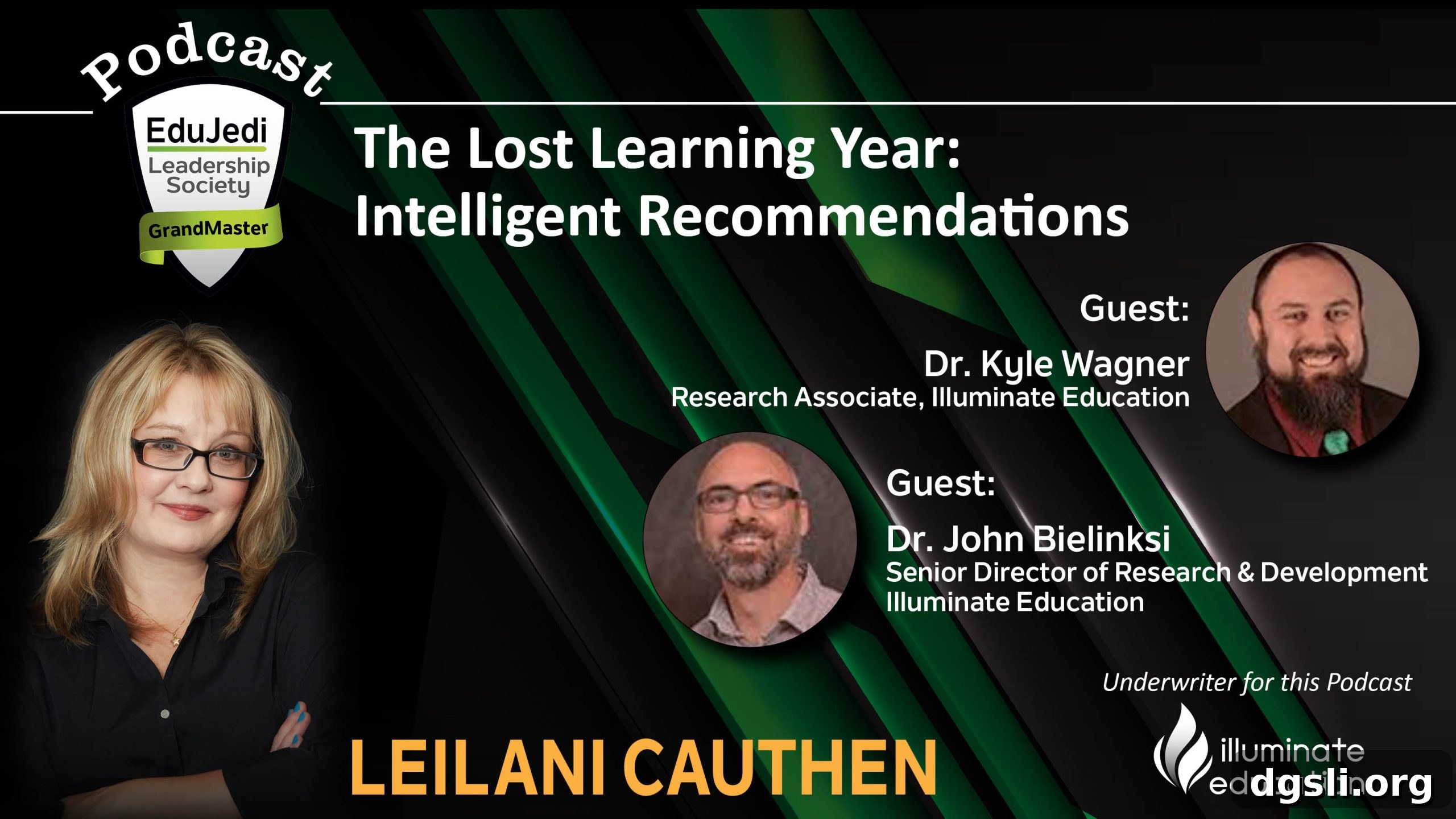
In this episode of The EduJedi Report Podcast, Learning Counsel CEO Leilani Cauthen explores recent research from Illuminate Education that examines how quarantines and prolonged remote learning have affected K–8 student outcomes. The study, conducted by Dr. John Bielinski and Dr. Kyle Wagner, analyzes assessment and growth data to estimate learning loss and identify where students are likely to begin the next school year. According to Cauthen, “Schools working through remote learning transitions have focused on engagement, but the data indicates that there is a clear hierarchy of needs and educators will need the tools to pinpoint risk quickly and make a recovery plan.”
Dr. John Bielinski, Senior Director of Research and Development at Illuminate Education, explains the approach the researchers used to estimate the impact on reading and mathematics for students in kindergarten through eighth grade. “If kids forget things over time, if they’ve been out of school for a long period of time, then there’s a loss of instruction,” Bielinski says. He and his team used historical cohort data and summer learning loss as a baseline to model likely outcomes. By combining known growth patterns with current assessment information, they projected where students would be at specific points in time and estimated how much instructional loss may have occurred.
The research focuses on measurable indicators in core subjects: reading and mathematics. Using longitudinal data from cohorts in kindergarten through fifth grade, the team projected back from a particular assessment date to estimate student status at the start of the upcoming school year. This method identifies gaps between expected growth and current performance, helping educators quantify the magnitude of learning loss and prioritize responses.
The implications of this analysis are practical and actionable for district and school leaders. First, the data underscores the need for precise diagnostic assessment to identify which students and which skills are most at risk. Rather than treating all learning loss as uniform, targeted diagnostics can reveal where foundational gaps exist so interventions can be focused where they will have the greatest impact.
Second, the research suggests a tiered approach to recovery. Schools should prioritize essential grade-level standards while differentiating instruction for students who need remediation on prerequisite skills. This may mean accelerating instruction for some students and providing intensive, small-group or one-on-one interventions for others. Frequent progress monitoring enables educators to adjust plans quickly and track recovery over time.
Third, data tools and dashboards that make risk visible to teachers and administrators are critical. Cauthen emphasizes that engagement alone is not sufficient; educators need reliable tools to pinpoint emerging problems and to plan measurable recovery strategies. When assessment results are easy to interpret and act upon, leaders can deploy resources—such as intervention staff, tutoring, or supplemental programs—more strategically and equitably.
Fourth, professional development and collaborative planning are essential components of an effective recovery plan. Teachers equipped to use diagnostic data and to implement targeted instructional strategies can more efficiently close gaps. Instructional coaches, grade-level teams, and cross-school collaboration support consistent implementation and continuous improvement.
Finally, attention to equity must guide recovery efforts. Students who faced unequal access to technology, unstable learning environments, or health-related interruptions are more likely to experience greater instructional loss. Prioritizing supports for these students—through intensive interventions, family engagement, and wraparound services—helps ensure recovery efforts reduce rather than widen existing achievement gaps.
Leaders can use the Illuminate Education findings as a basis for practical planning: assess broadly to identify where the greatest needs lie, triage and prioritize foundational skills, deploy targeted interventions, monitor progress frequently, and support teachers with tools and training. Taken together, these steps form a data-informed recovery strategy that responds to the uneven effects of prolonged disruption.
Listen to the Podcast