Op-Ed, Written by: Michael Snead, recently named ‘Teacher of the Year’ at Barton Middle School in Buda, Texas
Teachers across the education field continually search for practical, effective ways to help students succeed. In any typical classroom you will find students from many backgrounds: affluent and low-income, general education and special education, motivated learners and students who struggle to engage. Meeting the diverse needs of every student and guiding them all toward academic success is a challenge for even the most experienced educators.
As a special education teacher, I support a wide range of learners, with a primary focus on students with special needs. Although many of my students were able to participate and do reasonably well in class, they consistently struggled on formal assessments. Watching them fail tests despite their best efforts was heartbreaking and eroded their confidence. I made it my mission to find a dependable approach that would give these students a real chance to pass required exams.
I experimented with numerous tools and techniques — different programs, games, and review activities — until, after several months, I discovered Quizlet. Quizlet provides a suite of study tools that help students practice and master academic material. Accessible on both desktop and tablet devices, it offers a flexible mix of study modes, including digital flashcards, interactive games, matching activities, and self-testing options that adapt to how students learn.
The impact on my students and their families has been profound. I have witnessed smiles, relieved tears, and heartfelt gratitude as students began to see real results. Students who qualify for resource classes are earning top test scores in regular classes for the first time. Learners who had never experienced academic success before are now leading class discussions and facilitating small groups. For the first time in my career, I cannot tell which students receive special education support simply by looking at class performance or the grade book.
Quizlet’s benefits extend beyond special education students; it has improved outcomes for all learners in my classes. After last year’s success, our department adopted Quizlet at the start of the school year. Students begin accessing study sets before our units officially begin, allowing them to pre-study vocabulary and concepts. This early preparation enriches classroom discussions and enables students to engage with the material at a deeper level. As classroom rigor and discussion have increased, those improvements have been reflected in benchmark assessments.
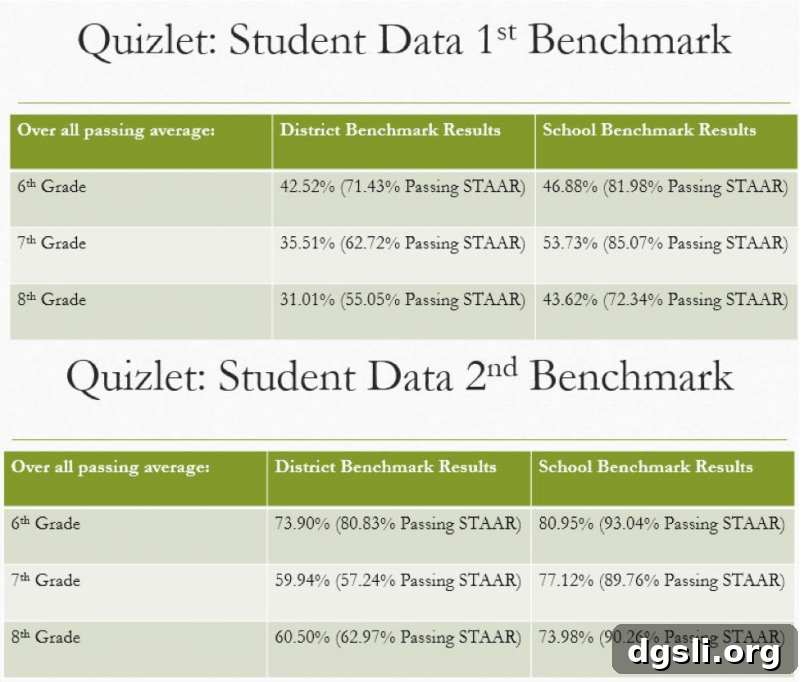
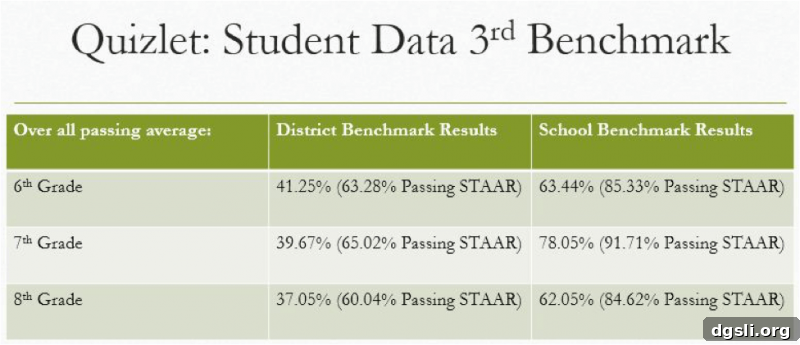
Our district administers benchmark tests every nine weeks, and the data shows clear gains where students used Quizlet regularly. After the first benchmark, our scores were slightly above district averages — a baseline before full adoption. By the second and third benchmarks, students had fully embraced Quizlet. Across three grade levels, scores for students using Quizlet were roughly 20% to 30% higher than other district averages. That improvement drew attention from district leaders, who wanted to understand how we achieved such a large performance gap. Of the approximately 700 students who took the benchmark, more than 450 used our class website linked to Quizlet study sets for the second benchmark, and over 375 used it for the third. Many more used Quizlet independently outside of school.
Consistent success with Quizlet does not happen by chance or at the last minute. As a department, we prepare review sets as soon as test dates are known, and in some classes the review sets are available when a new unit begins. Students need repetition and varied exposures to concepts to retain information. Our typical routine is to start with flashcards, progress to matching games and interactive activities, and finish with a Quizlet practice test the day before an assessment. This structured repetition allows students to build confidence and mastery over time.
Quizlet has made my job as a teacher easier and has amplified my students’ achievements beyond what I could have accomplished alone. That said, the platform alone is not a magic solution — teacher buy-in and consistent student engagement are essential. When educators and students commit to a study routine and experience tangible results, the possibilities expand dramatically. As one of my students summed it up perfectly: “When there is a will there’s a way. When there is a Quizlet, there is an A!”