
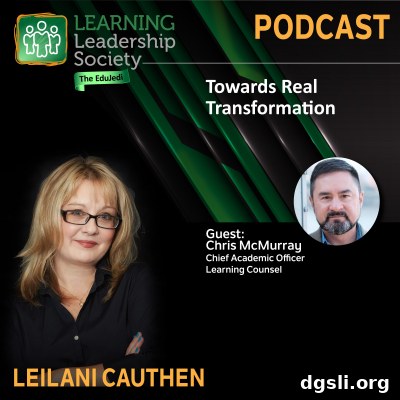
In this episode of the Learning Leadership Society Report, host LeiLani Cauthen interviews Chris McMurray, the Learning Counsel’s newly appointed Chief Academic Officer. As the Learning Counsel moves from advisory commentary into direct engagements with schools and districts, McMurray will lead efforts to support and guide institutions toward real transformation in teaching, learning, and operations.
Cauthen frames the context plainly: public education is facing a new reality. “There’s a new future being built. First, there’s a teacher shortage and almost every single district is talking about that. And the few that weren’t were experiencing other elements of the perfect storm, which is they’re losing students, there’s an attrition to the homeschooling movement and alternatives, that is just massive.” These pressures—staffing gaps, shifting enrollments, and the growth of alternatives to traditional schooling—are reshaping district priorities and creating urgent demand for practical, implementable solutions.
McMurray emphasizes that the Learning Counsel’s expanded role is designed to meet that demand. “The reason we’re deepening the service level from the Learning Council to school systems is because they need help, somebody to come alongside who not only has the crystal ball, but also has the implementation experience to do the things now required of school systems,” he says. To meet those needs, the Learning Counsel has assembled a package of supports within its Innovation Services division—most notably Advisory Schools and Hybrid Logistics—that provide targeted consultative and advisory services to districts and schools.
Click Here to Listen
What the new engagements aim to accomplish
The expanded engagement model aims to translate strategy into action. Rather than offering high-level forecasts alone, the Learning Counsel is positioning itself to help districts design and implement practical systems for staffing, curriculum delivery, technology integration, and student retention. Advisory Schools are described as consultative partners that work directly with leadership teams to align academic goals, instructional design, and professional learning. Hybrid Logistics focuses on operational and logistical solutions that support blended and hybrid learning environments—covering scheduling, resource allocation, and the coordination of technology and personnel.
Addressing teacher shortages and student shifts
Teacher shortages and student migration to homeschooling or alternative education models create both immediate operational challenges and longer-term strategic questions for districts. The Learning Counsel’s approach connects advisory expertise with implementation support to help districts stabilize staffing, expand educator capacity through targeted professional development, and redesign learning models to better meet diverse student needs. By combining experience in policy, classroom practice, and program logistics, the goal is to offer solutions that are realistic for the local context and scalable across districts with similar challenges.
Why implementation experience matters
McMurray stresses that having implementation experience is a key differentiator. Many districts need more than analysis; they need partners who can help translate recommendations into workable plans, pilot programs, and operational changes. Practical supports include crafting new staffing models, supporting teachers with curriculum and coaching, deploying technology to enhance instruction, and managing the logistics of hybrid or blended schedules. These pragmatic services aim to reduce the gap between ideas and execution so that schools can sustain improvement over time.
What schools can expect from Innovation Services
Innovation Services is presented as a bundled set of consultative offerings designed to be tailored to a district’s circumstances. Advisory Schools bring targeted academic planning and coaching. Hybrid Logistics addresses the operational side of instructional redesign so that new learning models are feasible and sustainable. Together, these services are intended to provide districts with both a strategic vision and the operational know-how to carry it out.
Conclusion
As schools navigate changing enrollments, workforce shortages, and evolving family preferences, the Learning Counsel’s move into direct district engagement seeks to provide timely, hands-on support. With Chris McMurray leading as Chief Academic Officer, the organization aims to combine foresight with practical implementation to help school systems achieve meaningful transformation in how they staff, deliver, and sustain high-quality learning.