
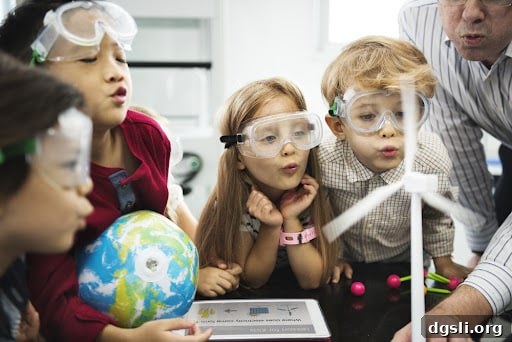
Do you remember a favorite science teacher or science class from high school or college?
Many of us recall a teacher who made science lively, witty, and unforgettable. Memorable demonstrations and imaginative lessons often turn curiosity into a lifelong interest. Whether a lesson about moon phases or plate tectonics, science should be a core part of every curriculum because it helps students interpret the world, think critically, and tackle real challenges.
What is Science?
Science is the systematic study of the structure and behavior of the physical, natural, and social world through observation and experiment. It’s a methodical pursuit of knowledge that relies on evidence and reproducible results, and it drives innovation and progress across industries and communities.
As described by The Science Council, science is the pursuit and application of knowledge and understanding of the natural and social world using a systematic methodology based on evidence. Core components of the scientific method include:
- Objective observation and accurate measurement
- Evidence-based reasoning
- Experimentation and repeatable observations to test hypotheses
- Inductive reasoning to derive general conclusions from specific data
- Repetition and reproducibility
- Critical analysis and skepticism
- Verification through peer review and open assessment
Teaching science goes beyond memorizing facts or formulas. It requires fostering communication, patience, rigor, and a healthy skepticism. Students who engage with science learn to ask better questions, evaluate evidence, and collaborate—skills that apply to virtually every area of life.
With an increasing emphasis on STEM education, it’s essential that schools provide hands-on science experiences that connect with students’ everyday lives. Early exposure to scientific thinking builds the background knowledge and logical reasoning students use in daily decision-making.
Here Are 5 Critical Life-Skills Students Can Learn From Science
Science Encourages Creativity
Science begins with curiosity: a question, an observation, a problem to solve. That open-ended starting point encourages students to test ideas, accept failure as part of the process, and iterate toward better solutions. Allowing room for experimentation nurtures creativity, resourcefulness, and problem-solving. Because scientific answers are rarely black-and-white, students learn to design experiments, interpret outcomes, and refine approaches—practices that foster innovative thinking.
Science Can Foster a Love of Learning
Science naturally fuels curiosity. Hands-on activities, experiments, and real-world investigations make learning immediate and engaging. Children are drawn to topics they can explore directly—touching, measuring, observing—and those experiences build enthusiasm that carries into other subjects. When teachers model excitement for discovery, students develop a durable love of learning that benefits their broader academic and personal growth.
Science Can Improve Critical-Thinking Skills
Critical thinking in science means asking rigorous questions and evaluating evidence thoughtfully. Students learn to probe issues with questions such as:
- Why does this happen?
- What evidence supports this idea?
- How reliable is the data?
- Are there alternative explanations?
- Is the information biased or verifiable?
These habits move learners beyond memorization into analysis, inference, and synthesis. Critical thinking develops through practice and experience—designing experiments, testing hypotheses, and interpreting results—so teachers must provide tasks that allow students to practice these skills firsthand.
Science Fosters Innovation
Although standardized testing can pressure classrooms to prioritize rote knowledge, effective science instruction emphasizes inquiry and application. Teachers who design lessons that tap into students’ prior knowledge and real-world concerns encourage them to think like engineers and scientists. Cross-disciplinary science activities can also reinforce mastery in reading, math, and technology while giving students opportunities to propose practical solutions to everyday problems.
An innovation-focused classroom values student questions, supports experimentation, and connects content to authentic challenges—creating a learning environment where curiosity leads to meaningful discoveries.
Science Builds Relationships—Especially for English Language Learners
Science instruction is inherently collaborative and multimodal, making it ideal for English Language Learners (ELLs). Rather than relying solely on vocabulary memorization, science lessons that incorporate visuals, hands-on activities, and guided discussions help ELLs develop language and content knowledge together.
Practical strategies for supporting ELLs in science include:
- Using pictures, diagrams, infographics, and models to clarify concepts
- Incorporating videos, virtual field trips, and real-world examples that relate to students’ lives
- Pairing hands-on experiments with collaborative group work and peer support from compassionate native speakers
Classroom projects that combine science and language—such as research on habitats, shoebox dioramas, songwriting about animals, or creating video presentations—encourage vocabulary growth, content understanding, and confidence.
As Tom Jenkins, an Albert Einstein Distinguished Educator Fellow, observes, learning science equips young people with the hows and whys of our dynamic world. When combined with the engineering design process, science education helps students apply knowledge to create solutions that benefit people and the environment. Ensuring equitable access to quality STEM learning prepares students to contribute meaningfully to society.
To engage all learners, teach science through experience rather than memorization. Hands-on inquiry, collaborative exploration, and real-world connections transform science from content to an essential set of life skills.