
By Charles Sosnik
If you ask a dozen educators to define personalized learning, you’ll likely hear a dozen different, passionate responses. As technology, pedagogy and culture shift, and as schools face pressure to raise achievement and reduce student attrition, the meaning of personalized learning keeps evolving. Today’s definitions range from modest resource differentiation to comprehensive redesigns of school structure and workflow.
Traditionally, personalized learning has meant tailoring materials and texts so students can reach a goal set by a teacher or district. In that model, students may use different resources, but the expectation remains that everyone will arrive at the same set of facts or competencies. That remains an important approach for many classrooms.
More recent approaches move beyond resource-level adjustments. They change where instruction happens, how students are grouped, and how time is organized. New-school personalized learning disaggregates the classroom and loosens rigid age-based grade groupings so students can be placed at the instructional point that matches their readiness. In practice this looks like individualized learning pathways with built-in options for targeted support. Some call related practices competency-based learning, but the essential idea is more flexible sequencing rather than a wholesale change to desired outcomes. Existing lesson plans can be sequenced end-to-end to form personalized workflows, while lectures become scheduled events or meet-ups and teachers can focus attention where it’s most needed.
Twenty years ago this might have sounded radical. Today, consumer technologies and workflow tools make it realistic. They allow learning experiences to be “consumerized” and schedules to be “uberized”—matching learners with the right resource at the right moment. This model both leverages teachers’ strengths and preserves the human elements of instruction, offering a practical path to elevate the teaching profession.
At the heart of this shift is a new model of workflow. In education, workflow means routing learning resources and information according to rules to accomplish learning goals. Workflow automation links systems, moves learning objects, and triggers tasks so that the right supports appear when learners need them. Teachers remain central, but their roles change: they use analytics and precise interventions rather than managing every procedural detail. Independent sequencing, automatic approval routing, and structured documents such as check sheets, course sheets and routing forms are common components. Some tasks can remain manual, while others are automated with simple, transparent rules.
Small private and rural schools have long used sequenced, often paper-based workbooks to manage learners of different ages with limited staffing. Scaling those practices across larger systems requires algorithmic engines that infer needs, auto-notify stakeholders, calendar events automatically and cohort students based on pace and achievement. As with any technology-driven change, the details matter.
Think of workflow as delivering exactly what a learner needs, just in time. This approach is already familiar in aspects of distance learning and higher education. Modern technology can do much of the coordination: when a learner reaches a point in a pathway, the right resource—a whole-group lecture, a small-group discussion, an instructional video or a lab—appears. Industries such as transportation and ride-sharing demonstrate similar matching systems: passengers are auto-cohorted onto flights or drivers are matched to riders. Education can borrow these scheduling and matching principles to align students with teachers, labs and live instruction.
Visualizing this model is often the biggest barrier. If a district can picture it, they can build it. That was the challenge the Learning Counsel set out to address before their annual Gathering, a retreat-style conference that brings together superintendents and district leaders to plan digital transition and strategy.
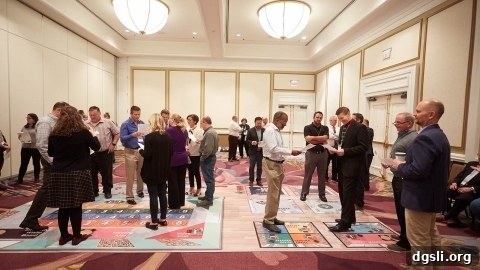
LeiLani Cauthen, publisher of Learning Counsel and a prolific education thinker, created an idea to help leaders see personalized workflow in action. Working with designer Dolly Johnson, she developed a human-scale board game that modeled a functioning personalized learning ecosystem. The game combined elements of a large, themed “House” space, classrooms, labs, a climbing wall and movement areas, plus informal spaces and a Guide who monitors analytics and adjusts instruction. The board simulated “just in time” resource delivery and allowed participants to play roles—students, teachers, guides—so they could experience the flow of a modern personalized learning environment.
Leaders who stepped onto the 10 x 24-foot game board acted out scenarios: a student redirected after a messy robotics lab, a teacher leading a small-group poetry session, and a Guide adjusting pacing based on analytics. The hands-on exercise helped district leaders see how workflows can coordinate whole-group lectures, small-group interventions and independent study. Many participants left eager to pilot workflow models in their districts, and some districts already reported planning subject pilots after the event.
The Game Rules
Each role in the game began with a short introduction:
“Today’s systems—digital curriculum combined with thoughtful workflow—can personalize learning at scale. Through personalized workflow learning, all students receive what they need when they need it. Schools can implement document-based workflow on top of digital curriculum systems and automated courseware. Full automation would add a few simple business-process algorithms rather than true artificial intelligence; human teachers and curriculum guides remain central.”
The game highlights a few automated workflow capacities:
- Decision Trees: Individual learning paths progress linearly until a learner encounters difficulty. Workflow should automatically direct that learner to a teacher or guide for temporary separate instruction or intervention. Progression to subsequent units can be manual or routed for teacher approval.
- Auto-Cohorting: Algorithms such as k-nearest neighbors (kNN) can group students who are at similar points in a pathway to enable targeted small-group lectures, labs or interventions. Cohorts can also be formed manually by monitoring progress.
- Auto-Alerts and Auto-Calendaring: Triggers based on student progress can automatically notify stakeholders and schedule lectures or small-group sessions.
- Structured Sequences: Check sheets and course sheets define when lectures, small groups and other activities are required. These remain decision points that can be human-controlled or automated as appropriate.
The board game simulates a microcosm schedule with about 14–20 people representing students, teachers, faculty and a Game Leader who calls “Turn” at short intervals so participants move through the day. Players mime actions—reading, writing, lab work, eating—so observers can see how changes in structure and workflow produce different outcomes. The setup uses a central House or homeroom for screen time with adjacent classrooms and activity spaces used as needed. Schools can also use longer, subject-focused blocks and still gain the same workflow flexibility.
The Learning Counsel team plans to bring the board game to regional events so more leaders can experience a modeled personalized learning system. As more districts understand and experiment with these workflow-engineered approaches, we can expect meaningful changes in how schools organize learning to better meet student needs.
About the Author
Charles Sosnik is an education journalist and Editor in Chief for the Learning Counsel. He draws on deep roots in the education community to add context to the education narrative and writes for influential outlets in the field. Charles is unabashedly Southern and describes himself as an editor by trade and Southern by the grace of God.