
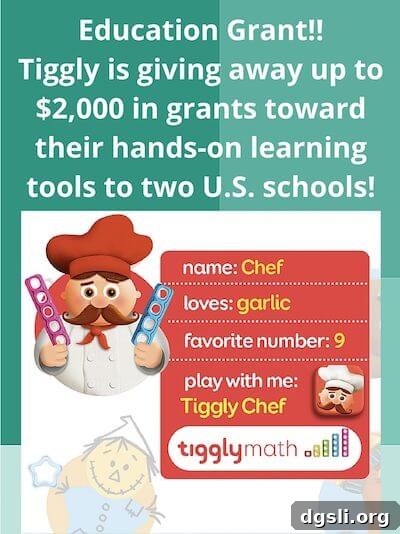
Tiggly Education Grant 2016
On April 21, 2016, the White House publicly recognized Tiggly for its role in advancing early STEM learning and affirmed the company’s commitment to supporting early education across the nation. As part of that commitment, Tiggly launched its inaugural Tiggly Education Grant to expand access to hands-on STEM learning tools for elementary students. This first annual grant program was designed to place Tiggly resources directly into classrooms and provide meaningful support to schools working to strengthen STEM foundations for young learners.
Grant Overview
The Tiggly Education Grant awarded two schools with funding of up to $2,000 each. One award was reserved for a Title I elementary school, reflecting a focus on schools serving higher percentages of students from low-income families. The second award was open to a public, charter, or private elementary school. These grants were intended to support the implementation of Tiggly in school settings, enabling teachers and administrators to integrate tactile, play-based digital learning tools into math, spatial reasoning, and early STEM instruction.
Purpose and Educational Focus
The primary goal of the Tiggly Education Grant was to broaden access to high-quality early STEM resources and encourage classroom innovation. By partnering with educators, Tiggly aimed to support hands-on learning experiences that connect physical manipulatives with interactive apps and digital activities. These kinds of resources are designed to strengthen early numeracy, shape recognition, sequencing, reasoning, and problem-solving—skills that form the foundation for later success in science, technology, engineering, and math.
Who Was Eligible
The grant targeted elementary schools. One award specifically supported a Title I elementary school, while the other was open to any public, charter, or private elementary school. Eligibility centered on the school level and mission alignment with early STEM learning; schools interested in receiving support were encouraged to demonstrate how Tiggly tools would be used to benefit students’ learning experiences and instructional goals.
How Schools Could Use the Funds
Schools using the grant funds typically applied them toward resources and activities that directly support classroom instruction. Examples of appropriate uses include purchasing classroom sets of Tiggly physical manipulatives and compatible apps, creating small-group learning centers, acquiring tablet devices or protective cases where needed, and supporting teacher training or planning time to integrate digital manipulatives into daily lessons. The grant intended to make it easier for teachers to incorporate tactile, interactive learning into math and early STEM curricula, helping students engage through play and exploration.
Why This Matters
Early exposure to hands-on STEM tools can spark curiosity and build foundational skills in a developmentally appropriate way. Programs like the Tiggly Education Grant help reduce barriers so schools can experiment with new instructional strategies and personalized technology that supports differentiated learning. Investments in early STEM education provide students with opportunities to develop critical thinking, spatial awareness, and confidence with mathematical concepts at a young age.
Learn More and Share
If you are an educator or school leader interested in the types of programs and resources Tiggly offers, visit Tiggly’s official website to explore their product lines, classroom ideas, and educational blog. The original grant announcement and supporting materials were also made available through education news outlets and communications related to the program.
Please share this information with colleagues, schools, and community organizations that may benefit from knowing about early STEM grant opportunities and the potential of tactile, technology-enhanced learning tools for young children.