
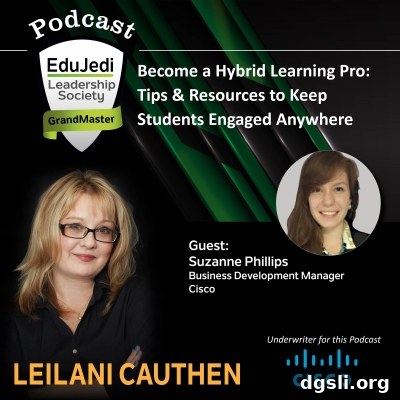
Making Virtual and Hybrid Teaching Human: Insights from the EduJedi Report
Host LeiLani Cauthen speaks with Suzanne Phillips of Cisco Webex about how educators can preserve human connection and engagement when students and teachers are separated by screens.
Why video conferencing became central to learning
When classrooms suddenly shifted away from in-person instruction, video conferencing moved from an optional tool to a core part of daily teaching. Early on, many teachers and students reported screen fatigue and disengagement. Those challenges raised important questions: how do we keep learning meaningful and accessible when interaction is mediated by a device? How can teachers replicate the energy and connection of a physical classroom online?
Learning from successful educators
Suzanne Phillips, who works with Cisco Webex, focused on answering those questions by collecting real-world strategies from teachers who were already succeeding with virtual instruction. Rather than relying on theoretical guidance, she and her team looked for reproducible practices and simple workflows that preserve the human side of teaching. The result is a set of practical tips, resources, and demonstrations that reflect how effective educators structure remote lessons, manage attention, and foster classroom community online.
Practical approaches that improve virtual learning
Across classrooms, a few consistent approaches surfaced as especially helpful:
- Design predictable routines and simple workflows so students know what to expect and can focus on learning instead of logistics.
- Create a welcoming ambience—use intentional camera framing, lighting, and voice practice to make online presence feel natural and approachable.
- Use interactive moments frequently to break up passive listening and reduce screen fatigue: polls, quick check-ins, breakout discussions, and visual cues can re-engage learners.
- Model technology use and keep transitions smooth so time is spent on teaching rather than troubleshooting.
- Learn from peers: share and adapt techniques that work in other contexts rather than trying to invent everything from scratch.
These techniques help teachers preserve social presence and sustain student engagement, even when teaching remotely or in hybrid settings.
Impact and reach
Early in the shift to remote learning, educators hungry for practical help sought examples they could implement immediately. Video-based tips and short tutorials resonated quickly: resources demonstrating approachable, classroom-tested methods saw widespread attention. According to accounts shared in the podcast, in just a few months educator-focused video conferencing tips reached a very large audience, illustrating both demand and the value teachers placed on pragmatic guidance.
Recommended resources for hybrid and remote teaching
To support teachers transitioning to hybrid and virtual instruction, several tailored resources are available that collect best practices, community discussions, and targeted training:
- Top resources for hybrid learning: https://www.webex.com/webexremoteedu.html
- Community space for teachers to ask questions and share strategies: https://community.cisco.com/t5/webex-for-education/bd-p/disc-education
- Free live training sessions tailored to educators: https://help.webex.com/landing/onlineclasses/upcomingClass/Education
These resources offer practical, classroom-ready ideas and opportunities to connect with other teachers working through the same challenges.
Listen to the episode
For a full conversation and real examples from educators, click to listen to the podcast episode: Click here to listen to the podcast.