

By Betsy Hill and Roger Stark
Editor’s Note: This is part two in a five-part series
In the first article of this Achieving Equity series we argued that one of the greatest barriers to educational equity in the United States is students’ cognitive capacity—because cognitive skills determine how students access and benefit from learning experiences, no matter how those experiences are delivered. We highlighted the urgency of addressing this issue in light of COVID-19 learning losses and the well-documented effects of poverty on cognitive development. Since education and economic opportunity are deeply intertwined, improving educational equity requires attention to cognitive development.
To address this challenge, we proposed three essential steps:
- Assess and understand each student’s cognitive strengths and weaknesses;
- Remediate and strengthen weaker cognitive processes while building on existing strengths;
- Design learning environments—technology, instruction, and curriculum—that follow scientific evidence rather than folklore.
This second article focuses on the first step: how to understand each student’s cognitive profile and why that understanding matters for teaching, learning, and equity.
Cognitive Skills That Underpin Learning
The phrase “cognitive skills” has gained wider recognition in education over the past decade. For clarity, it helps to describe specific types of cognitive abilities that form the foundation for academic learning. Important cognitive skill categories include attention, visual and auditory processing, sensory integration, memory, executive functions, logic and reasoning, and higher-order executive functions. Each category contains more specific abilities that influence classroom performance.
| Cognitive Skill Category | Example Skills |
| Attention | Sustained attention; selective attention |
| Visual Processing | Visual form consistency; visual span; visualization |
| Auditory Processing | Auditory discrimination; auditory sequential processing |
| Sensory Integration | Auditory-visual integration; timing and rhythm |
| Memory | Auditory or visual short-term memory; long-term memory |
| Executive Functions | Working memory; inhibitory control; cognitive flexibility |
| Logic / Reasoning | Visual thinking; conceptual/abstract thinking; verbal reasoning |
| Higher Order Executive Functions | Planning; problem-solving; strategic thinking |
Why a Cognitive Profile Matters: The Story of Bobby
When a student’s cognitive profile is unknown, educators and families can easily misinterpret the source of academic difficulty. Consider the case of “Bobby,” a 10-year-old who dreams of becoming an airline pilot. His math grades were strong, but reading comprehension was a persistent struggle. Bobby disliked reading and needed frequent prompting.
On a cognitive assessment Bobby’s spatial perception fell at the 91st percentile while his verbal reasoning was at the 3rd percentile. The rest of his cognitive scores were around average. Spatial perception refers to the ability to reason about objects in space—rotating, manipulating, and judging relationships among visual elements. Verbal reasoning involves inferring meaning from language, reading between the lines, and making predictions when information is presented verbally.
Without these assessment results, Bobby’s teacher might view him as unmotivated in English Language Arts because he struggled to interpret text or produce more than basic sentences, despite otherwise strong abilities. At home, Bobby’s parents reacted differently: his mother, an attorney with strong verbal reasoning, tried to explain texts verbally and became frustrated when that approach didn’t work. His father, who shared Bobby’s spatial strengths, used drawings and diagrams and had more success. Each parent relied on their natural strengths rather than aligning support to Bobby’s cognitive profile.
With targeted information, Bobby benefited from two interventions he might otherwise not have received. First, he was taught highly personalized strategies that leveraged his visual strengths—such as creating mind maps—to transform how he understood and remembered relationships among ideas in texts. This showed that true personalization is not only about what a student learns but how they learn best. Second, Bobby completed a 12-week cognitive training program that substantially improved his verbal reasoning score, moving him from the 3rd to the 46th percentile—shifting from a severe weakness to the middle of the expected range.
Research supports the view that cognitive skills explain a large portion of the variance in academic performance—more than many classroom and environmental factors. When learning struggles are misdiagnosed as purely instructional or motivational problems, students miss opportunities for targeted cognitive support that could change their trajectory.
Poverty, Executive Functions, and Classroom Impact
Bobby’s situation is an individual example, but in many settings the same underlying cognitive challenges affect whole groups of students. A substantial body of research shows that students growing up in poverty, on average, have less developed cognitive skills than their more advantaged peers. The most pronounced differences typically appear in executive functions—especially working memory and inhibitory control.
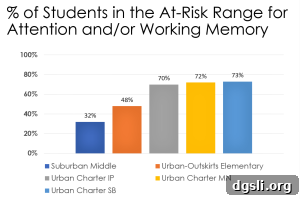
The data we have collected across a range of schools show that the percentage of students with clinically significant weakness in attention and/or working memory (defined as a performance at least one standard deviation below the mean) varies dramatically. In an affluent suburban district that percentage may be around 32 percent, whereas in several high-poverty urban charter schools more than 70 percent of students show significant executive function weaknesses.
When most students in a classroom have poorly developed executive functions, teachers understandably notice behavioral challenges. But executive functions are also essential to learning: inhibitory control prevents impulsive responses when decoding text; working memory holds information long enough to understand and integrate it with prior knowledge; both are crucial for reading comprehension, multi-step problem solving in mathematics, and sustained academic tasks.
Personalized classroom strategies—such as grouping students with similar cognitive needs, giving step-by-step instructions, and using external prompts—are important. Yet these accommodations are only part of a full solution. If we can build students’ underlying cognitive skills, we can expand their ability to learn independently and more effectively across subjects.
Coming in part three
The next installment in this series will explore the second element of the solution: how to remediate and strengthen both weaker cognitive processes and existing strengths so students gain more equitable access to learning.
About the authors
Betsy Hill is President of BrainWare Learning Company, which develops tools to build learning capacity through the practical application of neuroscience. An experienced educator, she has studied neuroscience and education with leading experts. She is a former chair of the board of trustees at Chicago State University and teaches strategic thinking in the MBA program at Lake Forest Graduate School of Management. She holds a Master of Arts in Teaching and an MBA from Northwestern University.
Roger Stark is Co-founder and CEO of BrainWare Learning Company. For more than a decade he has led efforts to bring comprehensive cognitive skills training and assessment within reach of many schools and families. He directed the development of BrainWare SAFARI, a widely researched online cognitive literacy training tool.
This article was originally published by The Learning Counsel, a research institute and news media hub focused on the shift in education to digital curriculum.