

Yesterday I joined a call on the current state of higher education and the status of America’s College Promise Act.
Below are notable quotes, key points, and an overview of America’s College Promise Act as discussed during the call.
1. “All students deserve the opportunity to gain the skills they need to succeed without drowning in student debt.” – Senator Tammy Baldwin
2. The proposal could expand access for as many as nine million students who currently lack access to community college programs. Senator Tammy Baldwin and Representative Bobby Scott have said the plan could save students roughly $3,800 in tuition per year.
3. “Higher education should be a path to shared prosperity, not a path into suffocating debt.” – Senator Tammy Baldwin
For ongoing updates, conversations, and online events, follow public statements from Senator Tammy Baldwin and Representative Bobby Scott and watch related social media hashtags such as #AmericasCollegePromise and #FreeCommunityCollege for news and community discussion.
America’s College Promise Act Proposal
U.S. Senator Tammy Baldwin (D-WI), a member of the Senate HELP Committee, and Rep. Bobby Scott (D-VA), Ranking Member of the House Education and the Workforce Committee, joined U.S. Secretary of Education Arne Duncan to announce H.R. 2962, America’s College Promise Act of 2015. The proposal aims to make two years of community college free and to create a more affordable pathway to a four-year degree for low-income students. The legislation is designed to strengthen workforce readiness and to help students gain the skills required in a 21st-century economy.
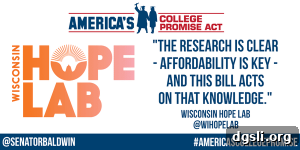
Under the proposal, more than nine million students at roughly 1,300 community colleges could benefit each year. In addition, nearly 300,000 students at about 280 four-year institutions— including Historically Black Colleges and Universities (HBCUs), Hispanic-Serving Institutions (HSIs), Asian American and Native American Pacific Islander-Serving Institutions (AANAPISIs), and other Minority Serving Institutions (MSIs)—would be eligible for support.
Representative Bobby Scott noted the financial pressure families face when trying to afford higher education. The America’s College Promise Act is intended to reduce that burden by expanding access to quality, affordable postsecondary options and by helping students earn credentials and degrees without taking on excessive debt.
For low-income students, the bill would create an explicit pathway to four-year degrees at qualifying HBCUs, HSIs, AANAPISIs, and other MSIs. As the economy and technology evolve, this legislation aims to help families obtain the training and credentials necessary to compete in a skills-based labor market.
How the bill works: The proposal provides a federal match of $3 for every $1 a state invests to waive community college tuition and fees for eligible students, applied before other financial aid. America’s College Promise would help cover a significant portion of tuition and fees for either the first two years or the final two years of college for qualifying low-income students who attend participating HBCUs, HSIs, AANAPISIs, and other MSIs.
Senator Baldwin emphasized that rising college costs and student loan debt are restraining economic growth and limiting opportunity. She argued that the United States must out-educate global competitors by preparing a well-trained workforce. The America’s College Promise Act, she said, would support workforce readiness and economic competitiveness by giving more students the chance to obtain postsecondary skills without crippling debt.
The America’s College Promise concept was originally proposed by President Barack Obama in his 2015 State of the Union address, with the goal of making two years of college as universal as high school had become a century earlier. Secretary Arne Duncan described community colleges as a uniquely American and critical segment of higher education—affordable institutions that are central to meeting national goals for college attainment and future prosperity.
You can find official summaries and full details of the America’s College Promise Act through congressional and education sources for the complete legislative text and implementation specifics.
Current House cosponsors
At the time of the announcement, H.R. 2962 had 61 House cosponsors, including Reps. Rubén Hinojosa, James E. Clyburn, G. K. Butterfield, Judy Chu, Linda Sánchez, Alma Adams, Seth Moulton, Mark Takano, Raúl M. Grijalva, Cedric Richmond, Corrine Brown, Danny K. Davis, Earl Blumenauer, Suzanne Bonamici, Madeleine Z. Bordallo, Brendan F. Boyle, Lois Capps, David N. Cicilline, Katherine Clark, John Conyers Jr., Mark DeSaulnier, Donna F. Edwards, Anna Eshoo, Chaka Fattah, Marcia L. Fudge, Al Green, Gene Green, Luis V. Gutiérrez, Janice Hahn, Mike Honda, Hakeem Jeffries, Joseph P. Kennedy, Derek Kilmer, Ron Kind, John B. Larson, Barbara Lee, Sandy Levin, John Lewis, Ted Lieu, Ben Ray Luján, Jim McDermott, James P. McGovern, Gwen Moore, Grace F. Napolitano, Donald Norcross, Eleanor Holmes Norton, Stacey E. Plaskett, Mark Pocan, Charles B. Rangel, Lucille Roybal-Allard, Bobby Rush, Gregorio Sablan, Loretta Sánchez, Adam Schiff, José E. Serrano, Eric Swalwell, Mark Takai, Norma J. Torres, Chris Van Hollen, Frederica Wilson and John Yarmuth.
Current Senate cosponsors
The Senate cosponsors included Senators Cory Booker (D-NJ), Sherrod Brown (D-OH), Ben Cardin (D-MD), Richard Durbin (D-IL), Martin Heinrich (D-NM), Mazie Hirono (D-HI), Patrick Leahy (D-VT), Ed Markey (D-MA), Chris Murphy (D-CT), and Debbie Stabenow (D-MI).
Organizational supporters
America’s College Promise had support from a broad coalition of education, labor, and advocacy groups, including the AFL-CIO, the American Association of Community Colleges (AACC), the American Federation of Teachers (AFT), the National Education Association (NEA), the Thurgood Marshall College Fund, the United Negro College Fund, the Hispanic Association of Colleges and Universities (HACU), the Association of Community College Trustees (ACCT), the National Skills Coalition, and numerous campus and community organizations focused on equity and higher education access.
Questions for readers: Do you think the America’s College Promise plan could work in your state or community? What questions or concerns do you have about how the program would be funded, implemented, or targeted to students most in need?