

By Zach Vander Veen
Across much of the world right now, parents are stepping into the role of teacher, or acting as hybrid educators when children are at home because of COVID surges or teacher shortages. In this prolonged pandemic context, many caregivers and educators are getting a crash course in instruction. A common question keeps coming up:
Is this working?
We mean: Is the way we’re teaching right now actually helping children learn? Is my child learning by reading a textbook, completing an online worksheet, attending a Zoom lesson, or by exploring concepts at home while I sketch out problems on paper? Which approaches are most likely to improve learning outcomes given limited time and energy?
Sometimes the question becomes more practical: if I can only do a few things well, what should I prioritize?
Visible Learning
Fortunately, researchers in education and cognitive science have examined what promotes learning most effectively. To make sense of the many studies, New Zealand researcher John Hattie synthesized hundreds of meta-analyses together into a single framework called Visible Learning. That work aggregates evidence from many studies and ranks influences on student achievement so educators and parents can see which strategies tend to produce stronger results.
Hattie’s approach aims to help teachers and families focus on practices that have the greatest impact on learning, rather than spending equal time on every possible activity. His synthesis creates a starting point for decisions about instruction during remote, hybrid, or in-person learning.
Effect Size
Central to Visible Learning is the concept of effect size. In brief, effect size is a statistical measure that indicates how strongly an intervention or factor relates to learning outcomes. Larger effect sizes show stronger relationships between a practice and student achievement, while small effect sizes indicate a weaker or negligible relationship.
In education research, effect sizes vary, and experts use different benchmarks to interpret them. Commonly, smaller values are seen as modest impacts and larger values as meaningful improvements. Hattie recommends using an effect size threshold to determine which practices are likely to produce the gains educators want to see.
This idea is important because almost everything teachers try will have some influence on learning. The question is not whether something works at all, but how much it helps compared with other options. Since time and energy are limited, it makes sense to emphasize approaches that consistently deliver the greatest benefits.
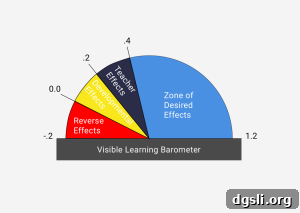
So what should parents and teachers do with this information? Use evidence to guide priorities. Focus first on high-impact practices and daily routines that support learning: clear learning intentions, constructive feedback, opportunities for students to actively practice and retrieve information, regular formative checks to monitor progress, and strong teacher–student relationships. These elements repeatedly show up in research as drivers of improved outcomes.
For parents juggling many responsibilities, this means choosing activities that combine engagement with clear goals. For example, instead of only watching a long instructional video, consider pairing a short, focused explanation with a hands-on task or a brief quiz to check understanding. If time allows, create small, meaningful moments—planting seeds to explore photosynthesis alongside a short conversation about sunlight and energy, or solving a few math problems together after a quick demonstration—so concepts are reinforced in different contexts.
Teachers can help by communicating clear objectives and sharing simple ways families can support learning at home: suggest specific practice tasks, provide concise feedback, and offer brief formative activities that reveal what students understand. When teachers and parents align on goals and use practices backed by evidence, learning becomes more efficient and purposeful.
Ultimately, everything we try can have some positive effect, but not all strategies are equal. Making choices based on research—prioritizing high-impact instructional practices, giving regular feedback, and focusing on clear goals—helps families and educators use limited time more effectively and improve student learning in this challenging time.
About the author
Zach Vander Veen has worked as a history teacher, technology coach, school administrator, and director of technology. He enjoys learning, teaching, travel, and family adventures. Currently, Zach is co-founder and VP of Development and Customer Success at Abre.io, an education management platform.