
When I was in middle school, I signed up for my first Spanish 101 class. As a native English speaker living in a bilingual community, I wanted to learn Spanish to better communicate and to connect with the cultures around me. I remember being intrigued by people who moved effortlessly between languages, and I wanted that skill for myself.
That decision set me on a long course of study: middle school classes, high school electives, and honors-level college courses. Learning a second language broadened my thinking, opened career paths, and made travel more rewarding. Even with modern translation tools, effective language learning still depends on purposeful strategies to support English learners and promote long-term success in language acquisition.
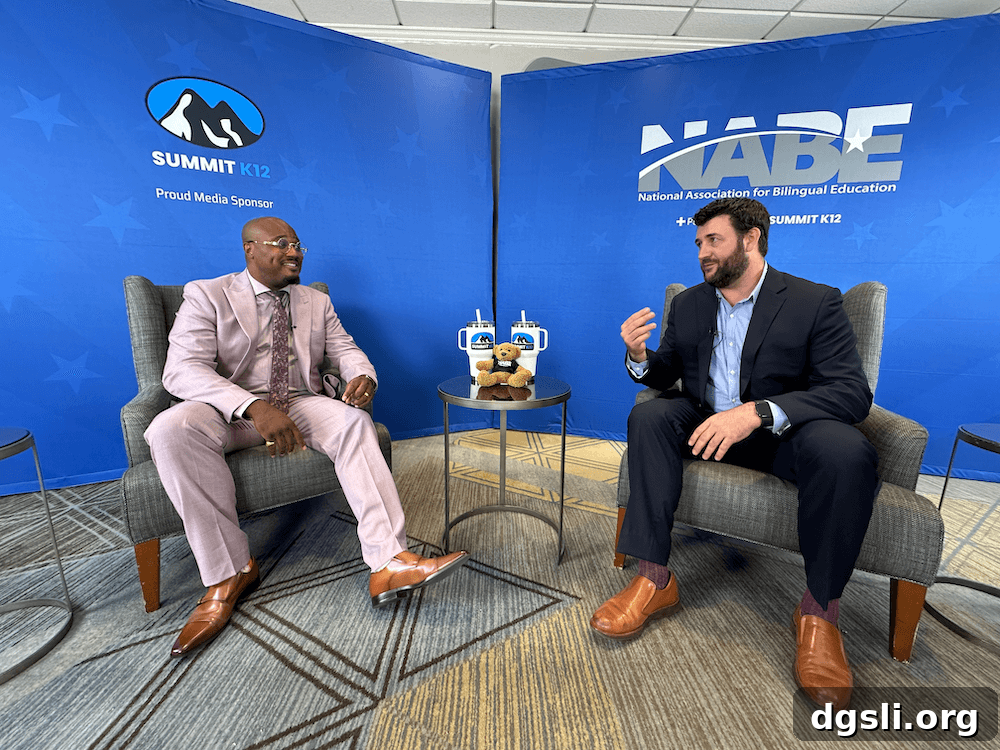
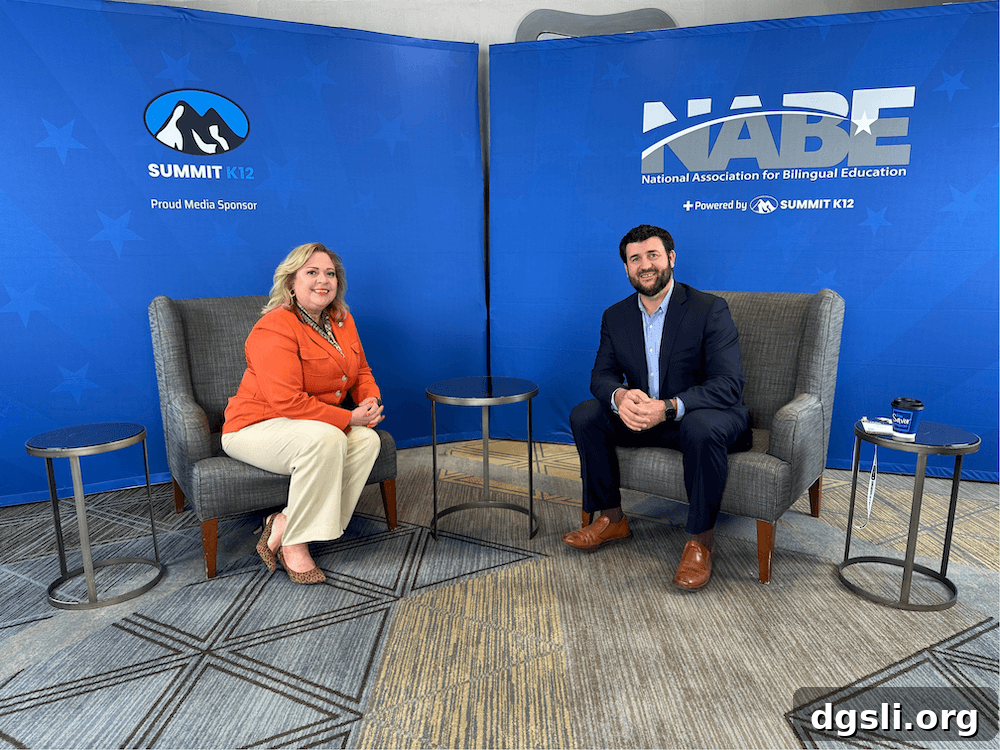
JW Marshall VP of Marketing at Summit K12 and Brandon Brown Founder and CEO of School Yard Rap on the media stage at NABE 2024. Image taken by Ricardo Santiago.
Teachers must remember that learning a new language requires time, practice, patience, and sustained effort. Maintaining a second language also depends on ongoing use and practice throughout life. Beyond individual effort, student outcomes depend on cultural and academic background, the classroom environment, teacher practices, and the structure of the language program in the school.
This article summarizes core theories of second language acquisition (SLA), highlights influential ideas from Stephen Krashen and Jim Cummins, and offers classroom activities that support multilingual learners.
What is Second Language Acquisition?
Second Language Acquisition (SLA or L2 acquisition) is the process by which people learn a language after their first language is established. SLA is both a practical process and a field of research that explores how learners develop competence in another language. It involves stages, cognitive and social factors, the learning environment, and different instructional approaches.
Key Concepts in Second Language Acquisition
Interlanguage
Interlanguage describes the evolving, rule-governed linguistic system learners create as they acquire a new language. It reflects influences from the learner’s first language combined with emerging patterns from the second language.
Input Hypothesis (Krashen)
Stephen Krashen’s input hypothesis emphasizes that comprehensible input—language slightly beyond the learner’s current level—is essential for acquisition. Krashen distinguishes between subconscious acquisition through meaningful interaction and conscious learning through study and formal instruction.
Acquisition–Learning Distinction
This contrasts natural, unconscious language acquisition with deliberate, conscious learning of rules and forms. Both play roles in development, but Krashen argues meaningful communication is the stronger driver of true acquisition.
SLA is shaped by age, exposure, motivation, cognitive skills, and opportunities for use. It intersects linguistics, psychology, and education, making it a rich area for both theory and classroom practice.
Multilingual Teaching: Theory and Practice
Teaching in a multilingual classroom requires strategies that honor students’ backgrounds and address the complexity of English—its dialects, idioms, and exceptions. Students must develop competence in four domains: reading, writing, listening, and speaking. Effective instruction blends meaningful interaction, scaffolding, and authentic, contextualized practice.
Krashen’s Stages of Second-Language Acquisition
Stephen Krashen has been a central figure in SLA theory. He proposed that acquisition resembles the way children learn their first language: through meaningful interaction where the focus is on understanding and conveying messages rather than on grammatical form. Krashen also described stages learners typically pass through as they develop proficiency.
Preproduction (Silent Period)
Learners often begin silently, focusing on listening and comprehension. They communicate through gestures, visuals, and nonverbal responses until they build confidence to speak.
Early Production
In this stage, students produce single words and short phrases. Vocabulary is limited, so teachers should use simple sentence structures and comprehension-supported activities.
Speech Emergence
Learners begin to form longer sentences and participate in basic conversations. Vocabulary grows and learners start to handle more varied interactions.
Intermediate Fluency
Students express ideas with greater accuracy and complexity, use more varied vocabulary, and communicate more confidently across contexts.
Advanced Fluency
Learners demonstrate near-native proficiency in many everyday and academic situations. They can read and speak about a wide range of topics and begin to master academic vocabulary.
Near-Native Proficiency
At this stage, a learner’s language use closely resembles that of native speakers, including understanding subtle meanings, cultural references, and nuanced expressions.
These stages are general guides rather than fixed timelines—individual learners advance at different rates depending on motivation, exposure, instructional support, and opportunity to practice.
BICS and CALP: Social Language Versus Academic Language
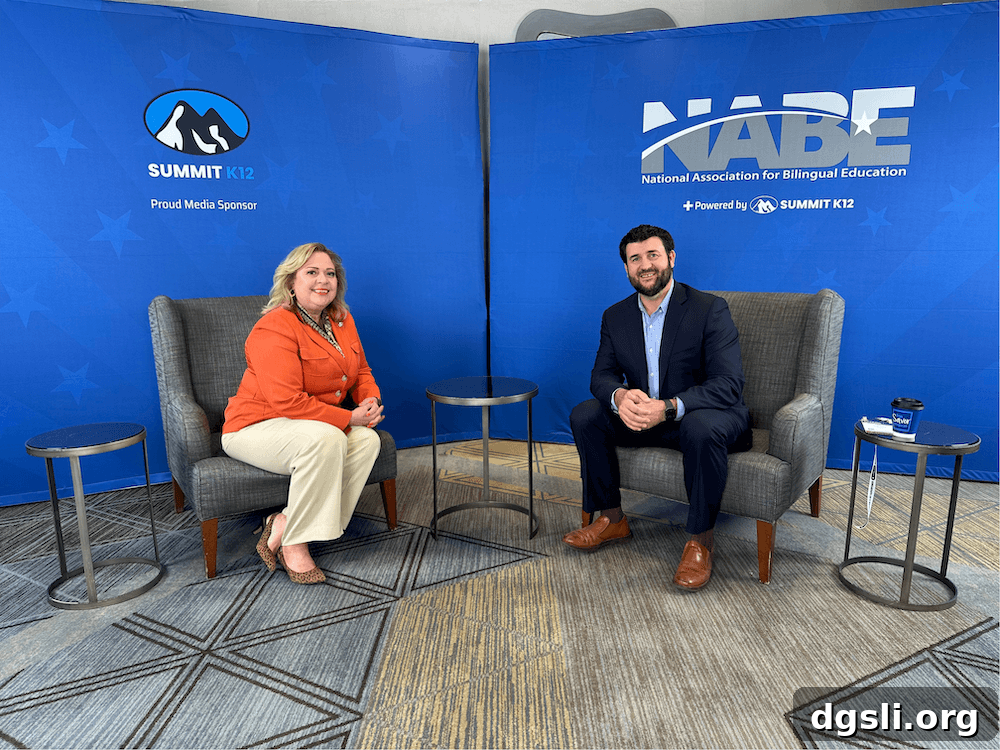
Judith Sauri NABE Treasurer and JW Marshall VP of Marketing at Summit K12 on the media stage at NABE. Image by Ricardo Santiago.
In the 1980s, researcher Jim Cummins identified a crucial distinction between social language and academic language: Basic Interpersonal Communication Skills (BICS) and Cognitive Academic Language Proficiency (CALP). He observed that students could appear fluent in casual conversation yet struggle with the academic language required for classroom success.
BICS refers to everyday, context-embedded language—conversational phrases, greetings, and informal interactions. These skills are typically less cognitively demanding and often develop within six months to two years of exposure.
CALP describes the abstract, decontextualized language used in academic settings—subject-specific vocabulary and cognitive processes such as analyzing, classifying, and synthesizing. Developing CALP takes substantially longer; research indicates it can require five years or more, and in some cases seven years or longer when learners lack formal support in either their native language or the second language.
Practical Activities and Strategies for Second Language Learning
Language learners need targeted, context-rich approaches. Below are practical, research-backed strategies to support multilingual students in the classroom.
Create Personalized Dictionaries
Have students build their own dictionaries—handwritten or digital—organized alphabetically or by topic. A personalized dictionary records new words with student-created definitions, example sentences, translations, and drawings. This encourages repeated encounters with vocabulary in meaningful contexts and supports speaking, reading, writing, and memory.
Use Culturally Relevant Materials
Connect language learning to students’ backgrounds by incorporating songs, stories, holidays, and visuals from their cultures. Emotional and personal relevance strengthens memory and helps learners form meaningful associations in the second language.
Apply Total Physical Response (TPR)
TPR uses movement and gesture to reinforce meaning. By pairing language with actions, teachers give learners a nonverbal route to comprehension. This approach is especially effective during the early, silent, and early production stages.
Prioritize Visual Supports
Visuals—photos, diagrams, videos, and contextual cues—provide essential context that words alone cannot. Visual media help learners infer meaning, reduce reliance on abstract explanations, and connect language to real-world situations.
Encourage Immersion and Interaction
Immersive opportunities—partner work, storytelling, and dual-language classroom activities—promote meaningful communication. Collaborative tasks that pair multilingual learners with peers foster language growth for everyone involved.
Avoid Long, Abstract Explanations
Lengthy, technical explanations can intimidate learners and replace experiential learning. Instead of long lectures, guide students with prompts, hints, and scaffolded tasks that let them discover language through use and interaction.
Which activities would you add? Effective classroom practice combines comprehensible input, frequent opportunities to use language, cultural relevance, and consistent, scaffolded support to help learners move from social fluency to academic proficiency.
Sources:
- Marilee Coles-Ritchie, “Personalized Dictionaries in the Content Areas,” Helping Multilingual Learners Thrive, 2024.
- Robyn Shulman, EdNews Daily, “Understanding the Difference Between BICS and CALP in English Language Acquisition,” 2019.