
By LeiLani Cauthen
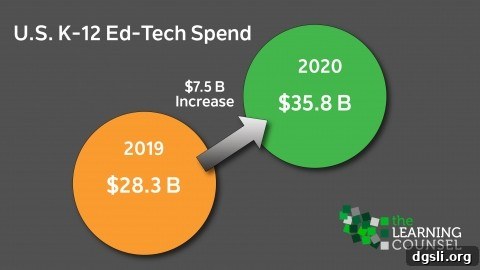
The U.S. K–12 education sector spent $35.8 billion on educational technology in 2020, covering hardware, major software systems, digital curriculum, and networking. That total represents a $7.5 billion increase from 2019, driven largely by emergency funding from the CARES Act and urgent investments to support remote learning. Many districts scrambled to provide devices, software, and rapid teacher training; one computer manufacturer reported selling more than 18 million machines to U.S. schools in under three months, and numerous respondents cited supply delays as demand surged.
Hardware and networking purchases accounted for $16.6 billion of the total—a $4.5 billion rise from 2019—while sales of major software systems reached $6.1 billion, up $900 million year over year. Digital curriculum spending grew to $13.1 billion in 2020, an increase of $2.1 billion over 2019. Spending on paper instructional materials declined by $1 billion to $6.9 billion in 2020. (Paper and print figures do not include staffing costs.)
For clarity, the report defines digital curriculum as digital textbooks and educational apps; curriculum subscription sites; digital lesson plans; online video subscriptions and libraries; online news services; adaptive or eLearning courseware; digital testing and assessment tools; and other digital learning content, excluding major administrative systems.
On average in 2020, a district spent $4.4 million on digital curriculum resources—about $154.69 per student. Additional expenditures from school budgets averaged roughly $210,000 per school, or $87.50 per student. Many schools reported using digital learning resources that typically cost between $2 and $7 per student per year.
The survey also examined consumer spending on direct-to-home digital learning. That market is estimated at $22.8 billion—approximately $9.7 billion more than the combined spending of schools and districts. As LeiLani Cauthen, CEO of the Learning Counsel, observed: “During quarantine parents increased their spending on consumer digital learning resources by over $1 billion in under six months. After a slowdown before the pandemic, consumer growth has returned at about 25 percent year over year.”
Key findings from the Learning Counsel’s 2020 Digital Transition Survey (32,827 participating educators):
- 87% of schools and districts now issue each student an individual computing device.
- 58% expect device purchases to increase; 25% expect device purchases to stay the same.
- 75% expect digital curriculum spending to rise (up from 70% in 2019).
- 13.46% report achieving full digital coverage for core subjects (math, language arts, science, social studies/history).
- 33.5% are considering purchases related to eSports equipment and software.
- 31% are considering social-emotional learning software systems.
- 33% are considering live tutoring systems.
- 39% report that 80–100% of teachers now use digital curriculum; 23% report 60–80%; 18% report 40–60%.
- The largest share of respondents (39.3%) reported a roughly even split between free and paid digital learning resources (50/50).
- Most respondents (34.55%) said digital curriculum and content make up 50–75% of the school day.
- Time spent by teachers searching for digital lesson materials increased markedly: those spending 4–10 hours per week searching rose from 32% in 2019 to 45% in 2020. In 2020, 7% of teachers reported spending more than 10 hours per week searching—up from zero in 2019.
- Teachers building their own digital learning content also rose: 4–10 hours per week increased from 22% in 2019 to 47% in 2020.
- The most common professional development topics were device training and digital communications (video conferencing and collaboration tools), each cited by 86% of respondents. Training on teaching practices and academic standards was cited by 84%.
- A notable weakness revealed by the pandemic: most instruction remains whole-group and synchronous. Over 62% of schools still primarily use whole-group models rather than personalized workflow learning, small-group instruction, project-based learning, or other blended approaches.
- 28% of schools and districts maintain decentralized planning for digital resources (teachers select and sequence content independently).
- 43% issue academic pacing guides in non-automated formats with limited digital references, leaving lesson planning largely decentralized.
- 29% have centralized digital resource and lesson plans organized by subject and grade—most of these are fully online schools.
- Tight budgets remained the top pressure point, cited by 47% of respondents. Social-emotional student needs and excessive testing tied as the second-highest pressure points at 41% each.
- Teacher shortages were identified as a major pressure point by 25%.
- Nineteen percent described an “overall disequilibrium” as a significant source of pressure during the transition.
- Both administrators and teachers ranked “using data to enhance teaching” as the primary marker of digital transformation. Teachers placed interactive whiteboards and video conferencing second; administrators prioritized reporting and analytics as their second choice.
The Learning Counsel Research division closed the 2020 Digital Transition Survey in October, with 32,827 educators engaging online and 1,234 full survey completions. Responses from small and medium schools and districts increased by 300% in 2020. Sixty-five schools, districts, and service agencies received Learning Counsel EduJedi awards in categories such as Gainer, Innovator, Achiever, and Knight.
Respondent demographics:
- 25% Urban
- 29% Suburban
- 39% Rural
- 7% Education service centers, BOCES, or state entities
About the author
LeiLani Cauthen is Publisher and CEO of the Learning Counsel.