
By Chris McMurray
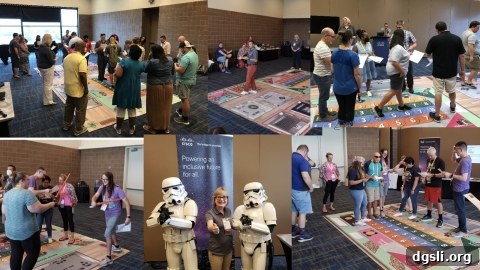
More than 200 school leaders and district representatives participated in a hands-on simulation of “uberized” learning at ISTE 2022 in New Orleans, June 26–29. The interactive sessions, presented by the Learning Counsel in partnership with Cisco and hosted in the conference facility, gave attendees a vivid demonstration of how advanced logistics can reshape hybrid learning. Participants left with light sabers that included sound effects, and many returned for a reception that even featured storm troopers — a playful touch to an otherwise serious conversation about the future of schooling.
The simulation introduced a disruptive model for rethinking education at a critical post-pandemic moment. As districts nationwide face teacher shortages, rising student attrition, and initiative overload, many school leaders are searching for alternatives that use time and space more effectively. Hybrid Logistics responds to that need by enabling personalization that goes beyond the usual age-based grouping into grades and fixed class schedules. At ISTE, educators were eager to explore how a dramatically different structure could advance equity and student agency.
Many attendees noted that, to date, their districts have mostly treated change as peripheral—adding online courses or supplemental tools—rather than redesigning the underlying structure of schooling. The simulation felt, to some, chaotic at first; to others, liberating. That sense of freedom came from witnessing a model that allows learning to unfold differently than the traditional bell-schedule, classroom-bound routines. A key insight shared in the pre-game briefing was that what often is missing is logistics: the capacity to coordinate the movement of teachers, learners, and resources so multiple personalized pathways can operate efficiently.
In the life-sized game, participants acted as human game pieces on a board designed to model an open and flexible learning environment. The structure deliberately breaks conventional constraints of pace, place, and time. Instead of a single linear progression dictated by seat-time and fixed classes, the model supports individualized pacing across content areas while preserving essential human instruction. Those moments of direct instruction—whether in large groups, small groups, or one-on-one—are treated as a premium feature in the hybrid logistics approach and are scheduled intentionally to maximize impact.
Before play began, attendees learned that true equity starts with recognizing that students learn at different rates in different subjects. Rather than pushing all students along a single sequence of lessons, Hybrid Logistics enables multiple designed paths, offering voice and choice so learners can pursue routes that fit their needs while staying aligned to learning goals. In the simulation, teachers and students moved independently through a mix of activities and spaces, intersecting as needed. This model increases opportunities for teachers to interact with students individually and in small groups, amplifying the human element in learning.
At first glance the activity looked random, until observers noticed that each participant followed a distinct set of instructions and a personalized path, guided by a simulated central infrastructure. The demonstration made clear how an added logistics layer—software and systems that orchestrate movement through time and curriculum—can personalize learning for every student while freeing teachers to focus on meaningful interactions. Post-game debriefs consistently showed how layering logistics on top of existing tools creates greater autonomy for students and gives teachers more flexibility to meet individual needs.
Key points discussed with school leaders included:
- Network readiness: Campuses and remote access systems must be reviewed and matured so that an “uberized” flow of people, devices, and resources can intersect precisely and securely.
- Network maturity path: During the sessions, Mary Schlegelmilch of Cisco described a natural maturity path networks can follow to become ready for this model.
- Existing structure: Most schools already operate a foundation of technology—student information systems, digital instructional materials, and courseware—overlaid by a human layer constrained by bell schedules and master schedules. Those time-and-space constraints shape how teachers and students interact and often produce inefficient use of resources.
- Hybrid Logistics Infrastructure: This concept adds a coordinating software layer between current technologies and the human layer to schedule and manage the movement of individual teachers and learners.
- Why it matters now: Research by the Learning Counsel has projected substantial teacher shortages moving into 2023, alongside continued increases in student attrition. These trends mean districts must become far more efficient with teacher time and far more intentional about personalization. A Hybrid Logistics model can help achieve those efficiencies, but doing so requires a mindset shift away from industrial-era models of schooling and collaboration across systems and partners.
In summary, ISTE offered a memorable and practical demonstration of how hybrid logistics could change learning. Attendees were able to physically experience new motion and options for personalized learning in a lively format that sparked conversation and interest. Organizers have already received requests to reprise the game, and Learning Counsel invites interested educators and leaders to learn more through upcoming events and its Expo Achievement Schools activities.
About the author
Chris McMurray is Chief Academic Officer at the Learning Counsel.